
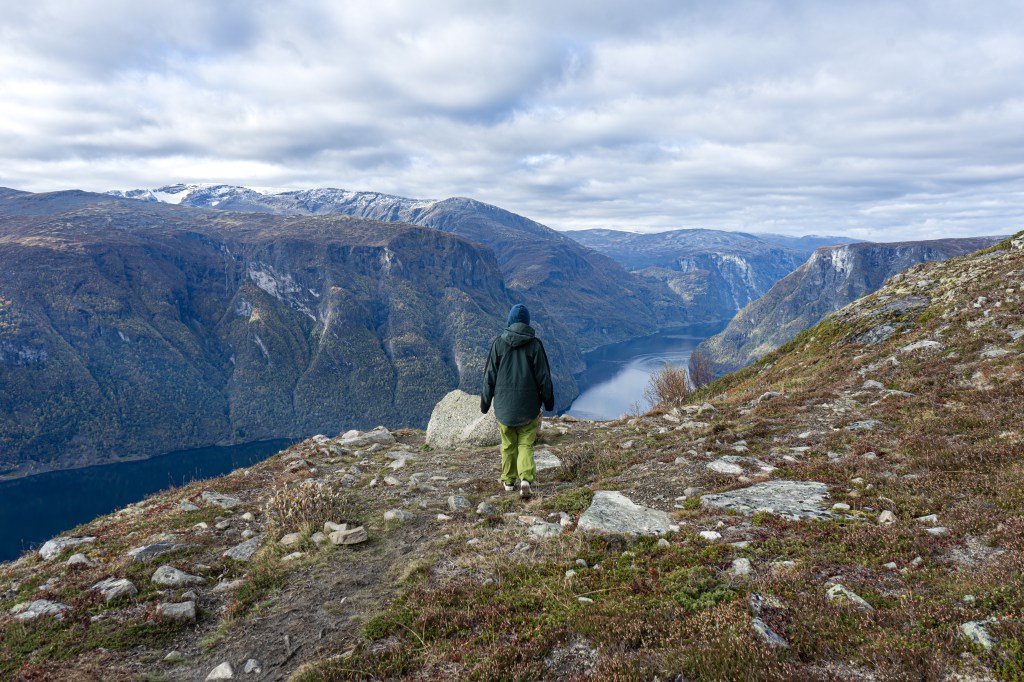
A brief trip through the Norwegian fjords
Specs
Location: Vestlandet, Western Norway
Lug to lug: approximately 5 days to 3 weeks depending on how you measure it
TLDR
Norway has some of the most spectacular natural beauty that I’ve ever seen in person. It’s the home of the majority of my family who I don’t get to see often and the country holds a special place in my heart. While Norwegian cities are charming, the real adventure in Norway is found among the mountains and fjords. This journal simply documents one possible adventure to have within a week in western Norway. The article is long so just check the gallery (lots of extra pictures at the bottom) if you don’t like reading. Oh ya, no watches in this one, sorry to all my legions of watch followers. I’d make a separate travel blog, but I don’t feel like paying for another domain. I did do some Exploring on this trip, however, and that means I’ll have a watch post out soon. We’ll call this column… WhereYaGone?
Det var en gang…Once upon a time…
When I was a baby, like many proud first-timers, my parents purchased me my first bunad, the traditional Norwegian costume; think lederhosen, but more formal and with less beer stains. It was the first taste of tradition that connected me to my father’s nationality. Wrapped in my Norsk swaddling gear, the first tufts of white-blond hair whispering across my oversized, round head set with two pale blue eyes, I was the poster child of Norwegian-ness. But despite my early rite of passage, as well as many trips to the fatherland throughout my childhood and young adulthood, and not to mention my dual citizenship, I have never felt much like a Norwegian. Growing up in Kentucky and living my whole life in America speaking only English like such a typical American, I always felt like a pretender. That’s why I finally took it upon myself to learn my own language. No, this is not sponsored by Duolingo but it may end up sounding like it because after a streak of 568 days of practice I’m proud to say that I can actually kind of speak Norwegian. At least I can converse intelligently with a 7 year old child, and for me that’s something to be proud of. But to put it to the test I packed my bags and headed across the pond to the land of the ice and snow, of the midnight sun where the hot spri…oh wait that’s Iceland.
From Bryggen with hygge
My trip began in Bergen, Norway’s second “largest” “city” located on the western coast by the North Sea. Home to around 420,000 people (including the larger metro area) and with a quaint and historic town center, Bergen is the perfect koselig (that essentially means cozy and applies to most things in Norway) sized place to begin a visit in Norway. Far more charming than the perhaps more cosmopolitan capital of Oslo, and located closer to many of Norway’s iconic fjords, Bergen has always been a stop for me when visiting family. The city is expensive, but lodging is actually free. Simply stay with your cousin and her family.
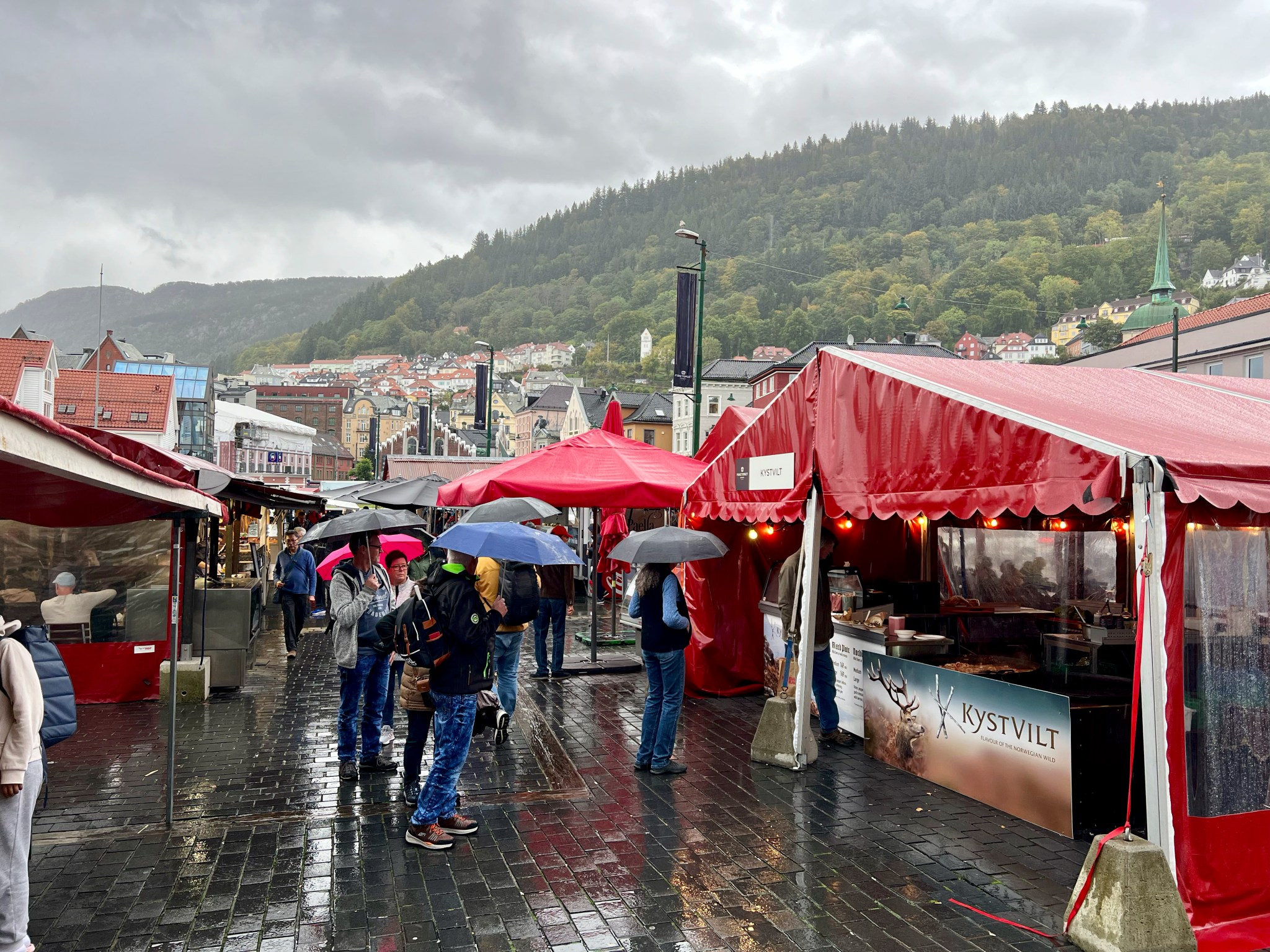
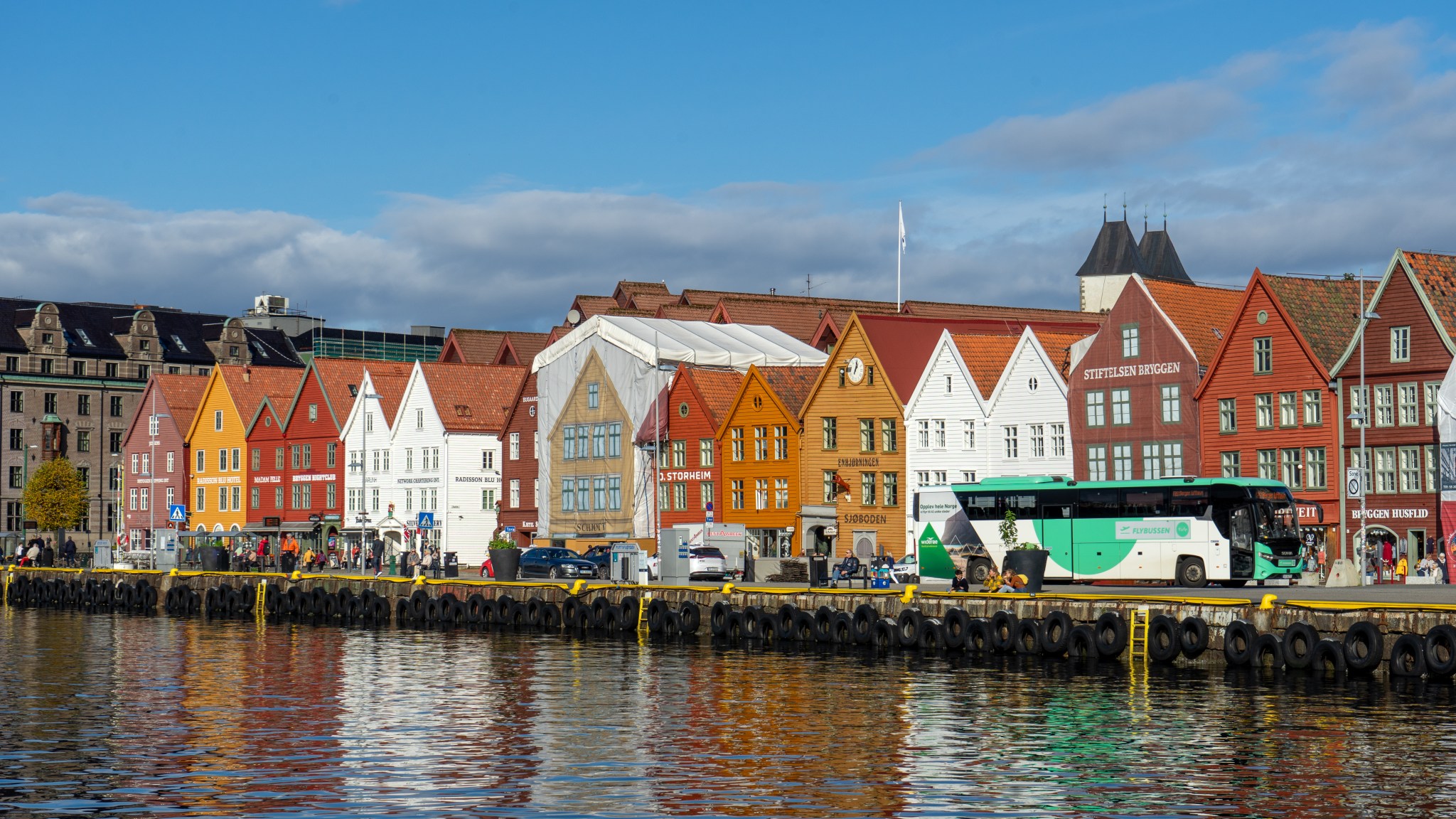
To start, I took a stroll down to Bergen’s most iconic location, Bryggen, where one can enjoy some fresh fish at the charming red tent market. The design of the beloved, crooked little buildings of Bryggen date back to the 18th century, but the spot was inhabited well back into the Middle Ages before eventually becoming the northernmost major port of the Hanseatic League. The traders controlled the stockfish (unsalted but dried, preserved and transportable) trade for centuries. Fires have unfortunately ravaged the area, most recently in 1955, but all repairs have faithfully preserved the 18th century design.
Today, when undergoing renovation, the buildings are covered in adorable tents with life-sized renderings of the structures inside. So while it’s always sad to visit a historical place under construction, at least in Norway you get an idea of what is hiding beneath.
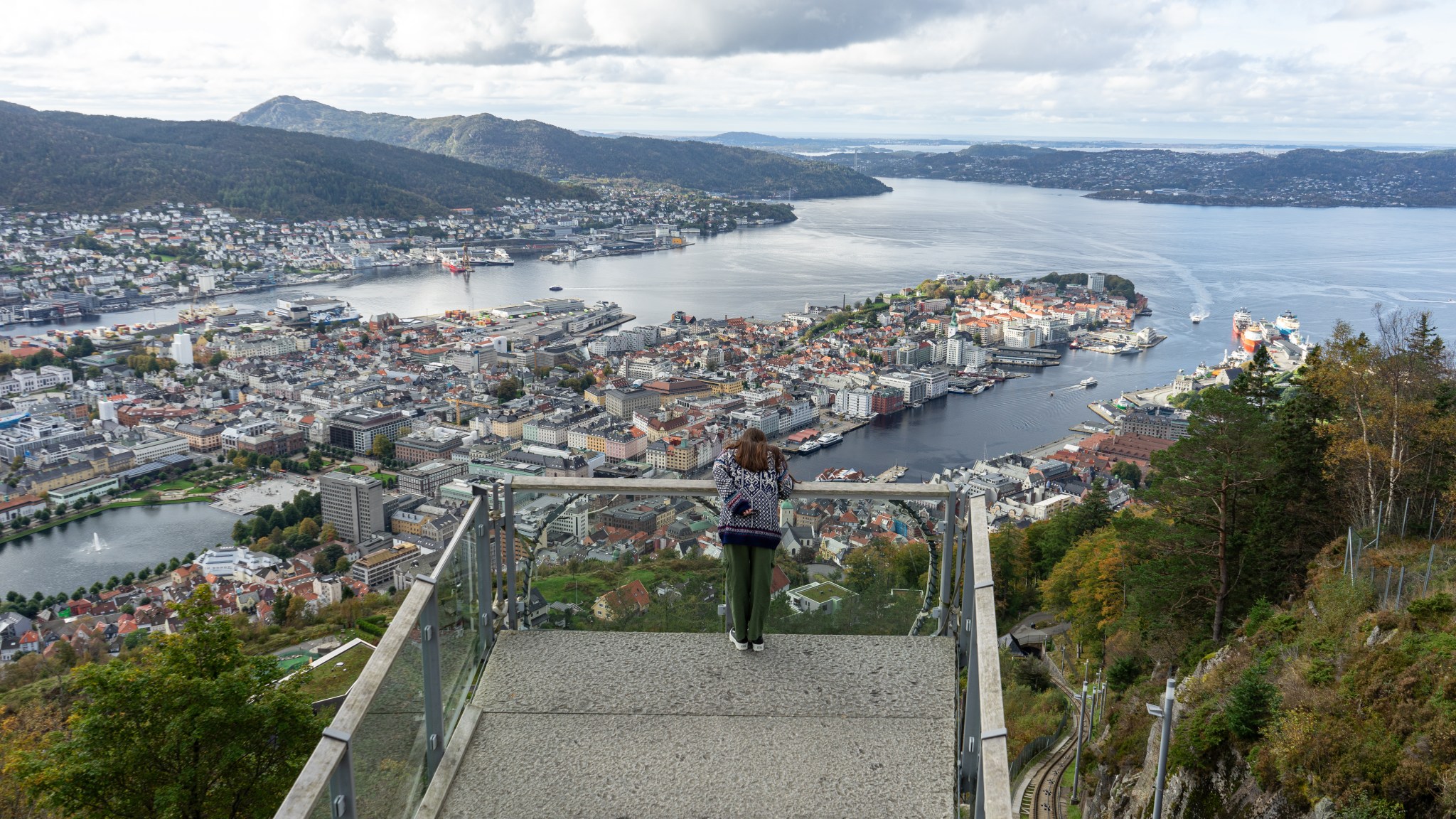
Bergen as seen through Odin’s one eyed crow
After about two weeks of solo travel and some long-awaited quality time with my family in Vestlandet, my girlfriend joined me in Bergen. Thankfully, one of my aunts dressed her in a hand knitted Norwegian sweater so she’d blend into the crowd and not draw too much attention as an obvious foreigner. Norwegian camo. To get a better idea of the lay of the land we headed to the top of Fløyen.
The journey up the mountainside is half the fun. Fløibanen is a funicular railway, meaning that the two tram cars are counterbalanced and permanently attached via a cable. As one tram comes down the mountain, the other ascends at the exact same speed. A fun tourist attraction, it’s also a legitimate form of public transportation for the many people who live high up on the face of the mountain. I pity those poor people who have to sit beside obnoxious tourists like me on their daily commute. One can also enjoy a long and breathless walk up to the top if you want to warm those legs up for your subsequent hiking trip. We took the train.
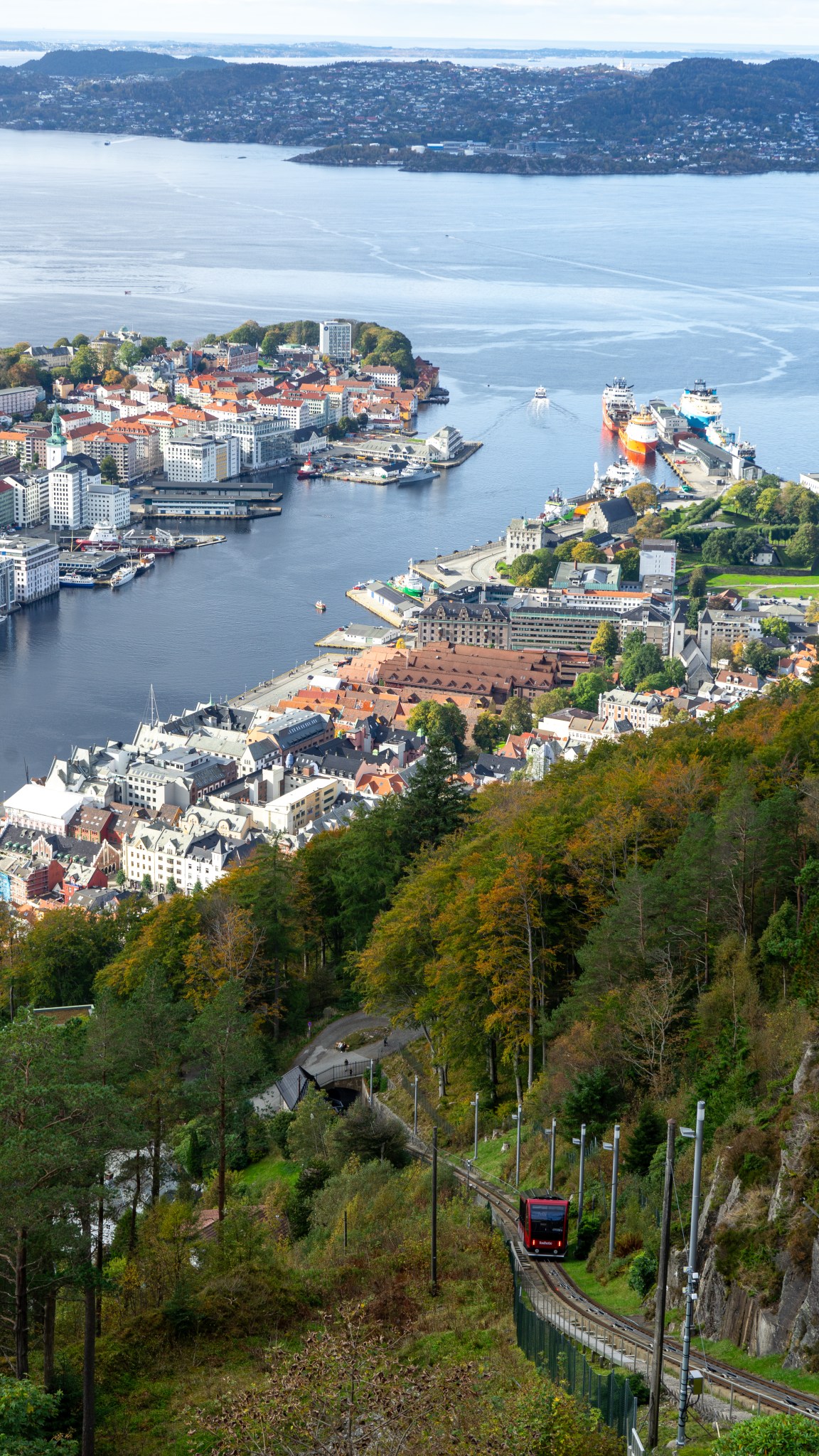
From the peak, we were treated to a spectacular view of Bergen’s landscape. It’s a small town and from the high perch you can see all the places you’ve been before with a new, bird’s eye perspective. Usually, a cafe and restaurant are open at the peak but these were closed when we visited. No matter, the best food can be found below on the streets of the city.
Viking food
If you go to Bergen, go to Pingvinen. No questions asked, just go. I am not sponsored by them, nor by anyone, and don’t make money off of this. I just want to share good, simple things with the world and Pingvinen is quite simply very good. It’s a koselig (get used to that word) pub that offers amazing beer from local microbreweries and serves up some of the best Norwegian comfort food I’ve had. If you go on Thursday you can treat yourself to an important traditional dish known as raspeballer, big white balls of potato and flour presented alongside (very) salted lamb and Voss mutton sausage. It’s potatoes with a side of potatoes and meat. Oh ya and some rutabaga. And lots of butter. Also some very fatty bacon crumbles. Sure, it’s indulgent and high in calories, but you’ll be walking those off in the Norwegian mountains soon and you need good Viking food to fuel your Viking body.
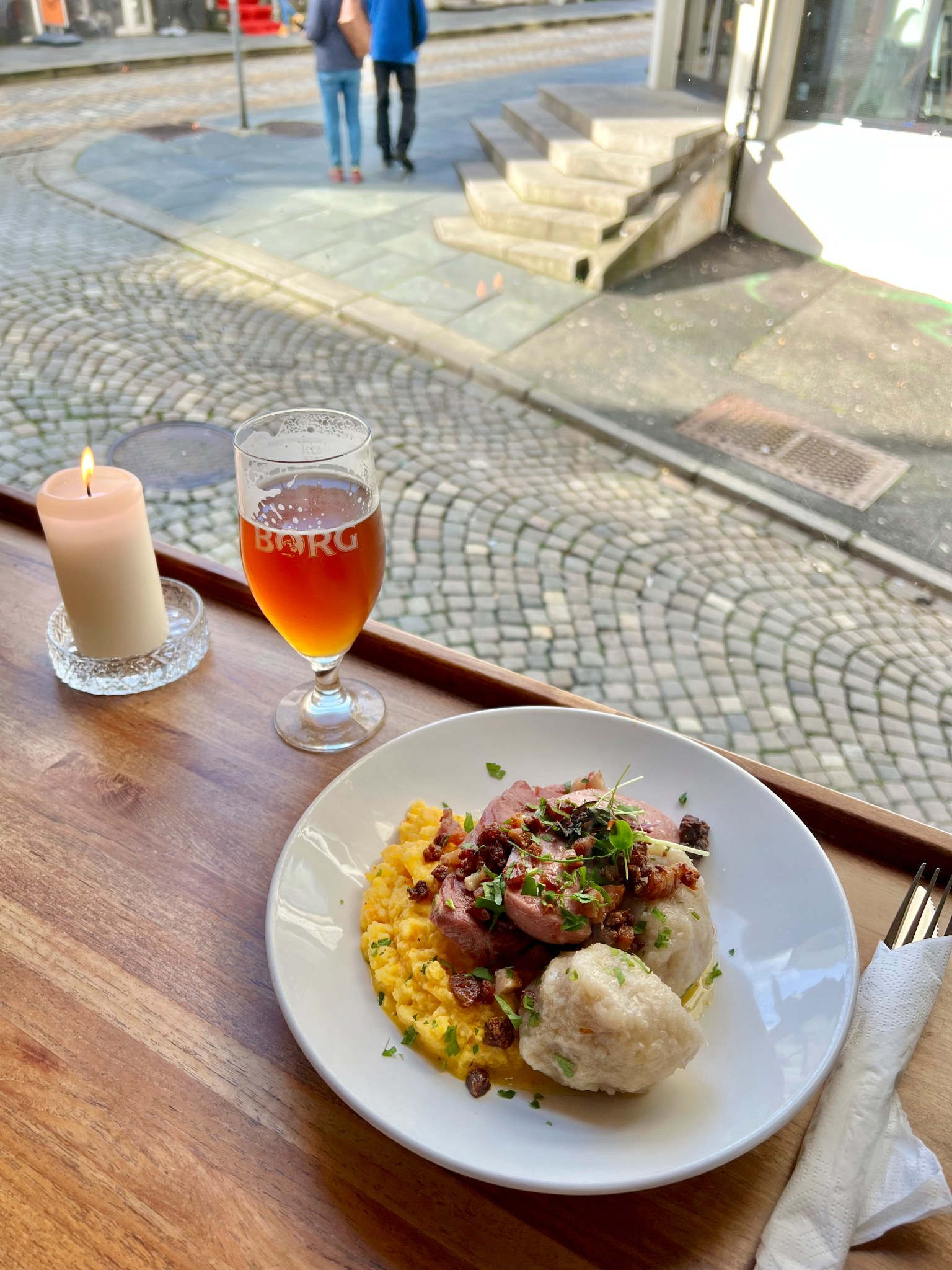
Well akstually…if we’re concerned with accuracy, Vikings didn’t have potatoes, and despite having contact with the New World centuries before Columbus (sOrRy ItAlIaNs!) the American crop wasn’t introduced to Norway until much later, eventually becoming a staple. I asked my cousin’s boyfriend why raspeballer are usually only served on Thursdays. He said with a laugh, “I don’t know, tradition maybe.” Like all good traditions, most people don’t know why they do them, they just do them. Ok, maybe that’s a bad thing, but in this case I think it’s quite harmless and I’m sure it’s very tasty.
For equally delicious yet less gluttonous vegetarian (as well as meat) offerings, simply walk across the street to The Daily Pot. I got the yellow pot and I’ve been trying my best without success to recreate it at home ever since. Nothing like a creamy, hot stew on a typical rainy Bergen day to warm the soul and nourish the cold body.
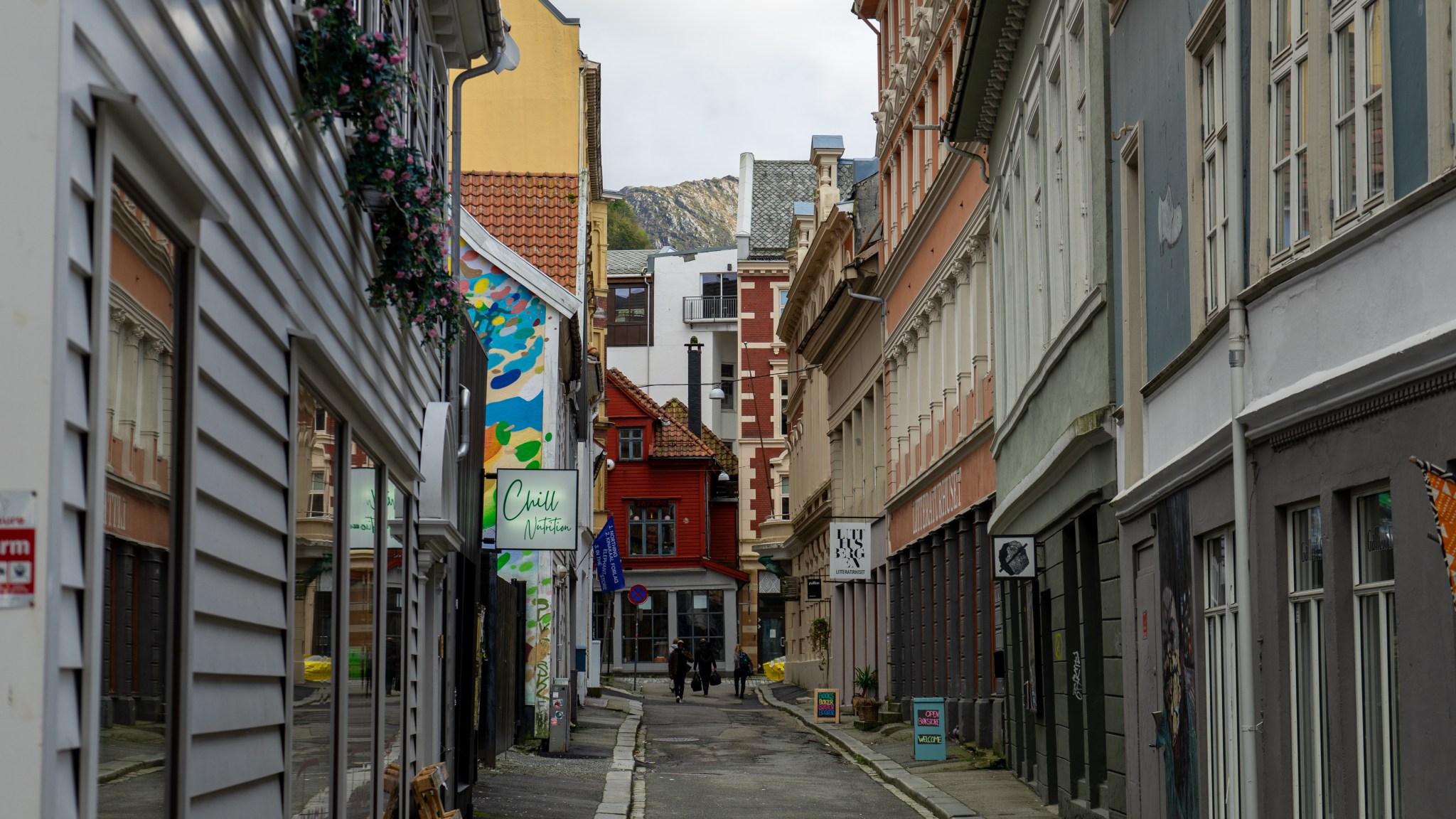
Slippery when wet
Oh ya let’s talk about the rain. Bergen is rain. Rain is Bergen. At least in October. If you think, “well today it looks nice out, perhaps it won’t rain today,” it will rain today. If you want to visit Bergen you want to visit rain and therefore you should come prepared with serious rain gear. Or, you could be like me and forget rain gear and just buy a new rain jacket with a 100% markup compared to the American price. However you go about it, you need waterproof (not just water resistant) clothing including shoes. I’d recommend GoreTex, but that is killing the planet as well as you so perhaps some alternative non-PFC (perfluorocarbon) material like those offered by Patagonia or even the Swedish Fjällräven. I don’t usually like to support those stinking, dirty Swedes, but I have to commend that company for its refusal to use PFC’s all along. Always out-virtue signaling us.
Damn Swedes.
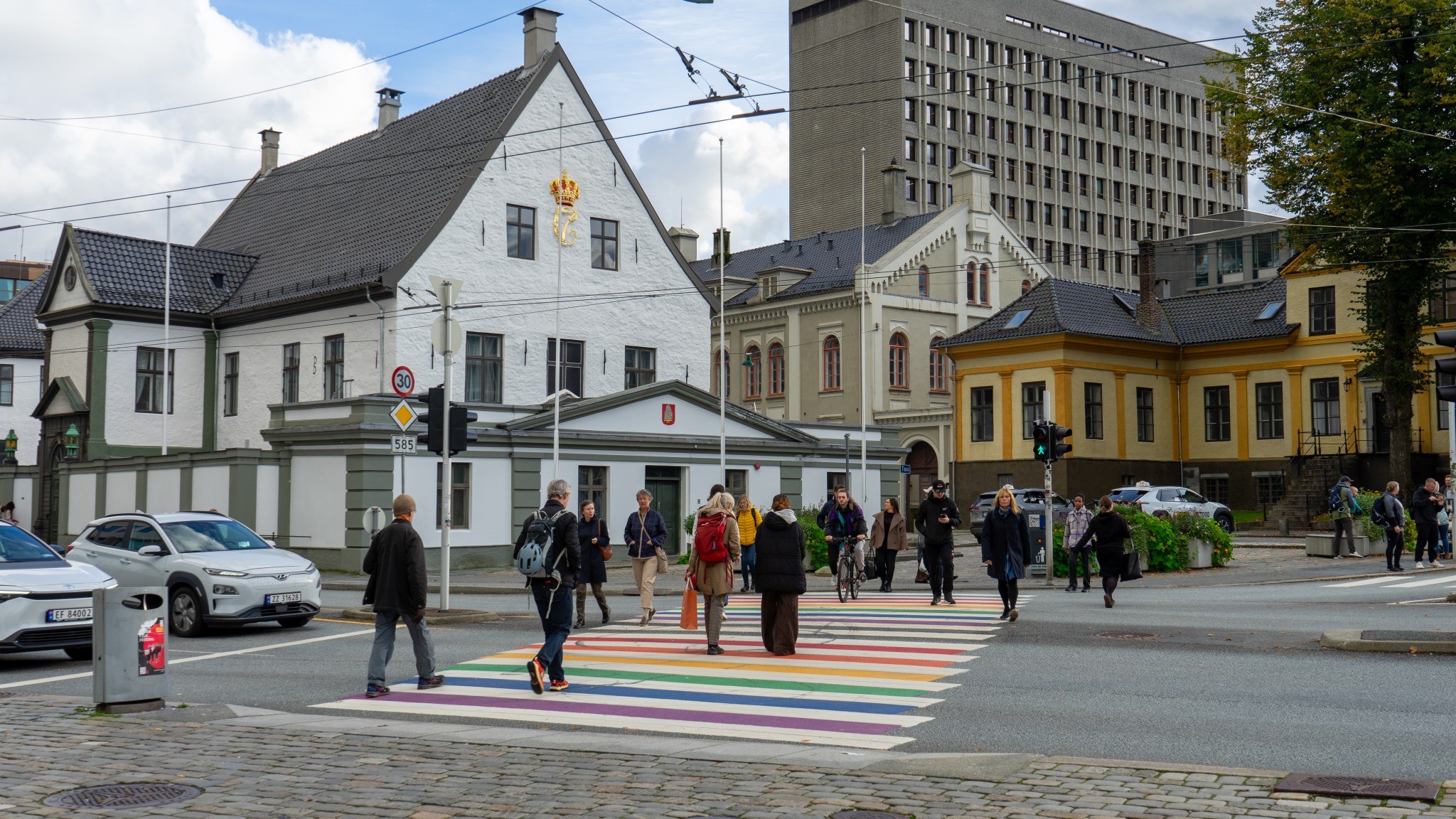
Once you’re safely zipped inside a water proof shell, the rain only seems to add to the city’s charm. The warm, candle-lit pubs and cafes feel that much more koselig. The many museums offer an even more welcome respite from the elements outside and the fresh fish at Bryggen taste a little fresher seeing as they never truly left the water. Fortunately, though it rained every single day all day for the first two weeks, the weather broke just in time for my girlfriend’s arrival and it only rained half the day most days (that’s when I pulled my DSLR out and hence why it doesn’t look so bad in pictures).
Go east, my son
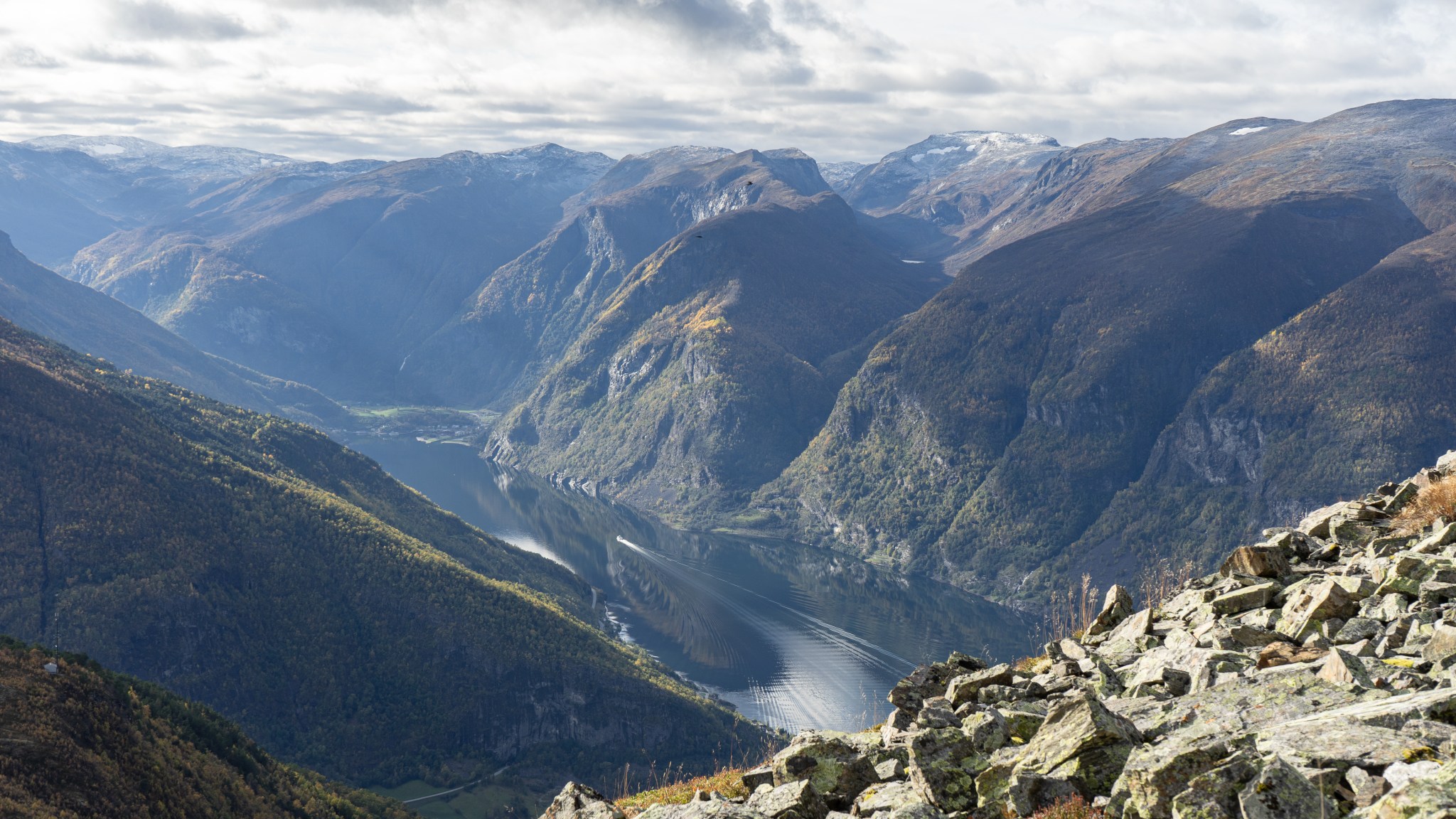
Don’t tell my cousin who is reading this, but one shouldn’t spend too much time in Bergen, or any city for that matter. The true beauty of Norway is found in its nature and countryside towns. I had already spent time a couple hours north of Bergen alone and made my way back in a roundabout way via another eastern road. It was this area to the east, Nærøyfjorden, that I decided would be the best place for a Norway crash course trip for my girlfriend and I highly recommend the area to anyone visiting Norway for the first time.
It’s possible to book a “Norway in a Nutshell” trip right from Bergen where all transportation will be provided, or you can take an ordinary bus. To get the real modern Norway experience, however, I rented an electric car, the Volkswagen ID3 to be specific. I mainly picked it because it was actually the cheapest car to rent as well as the cheapest to “fuel.” With petrol at $9/gallon electric is an infinitely more affordable option in Norway.
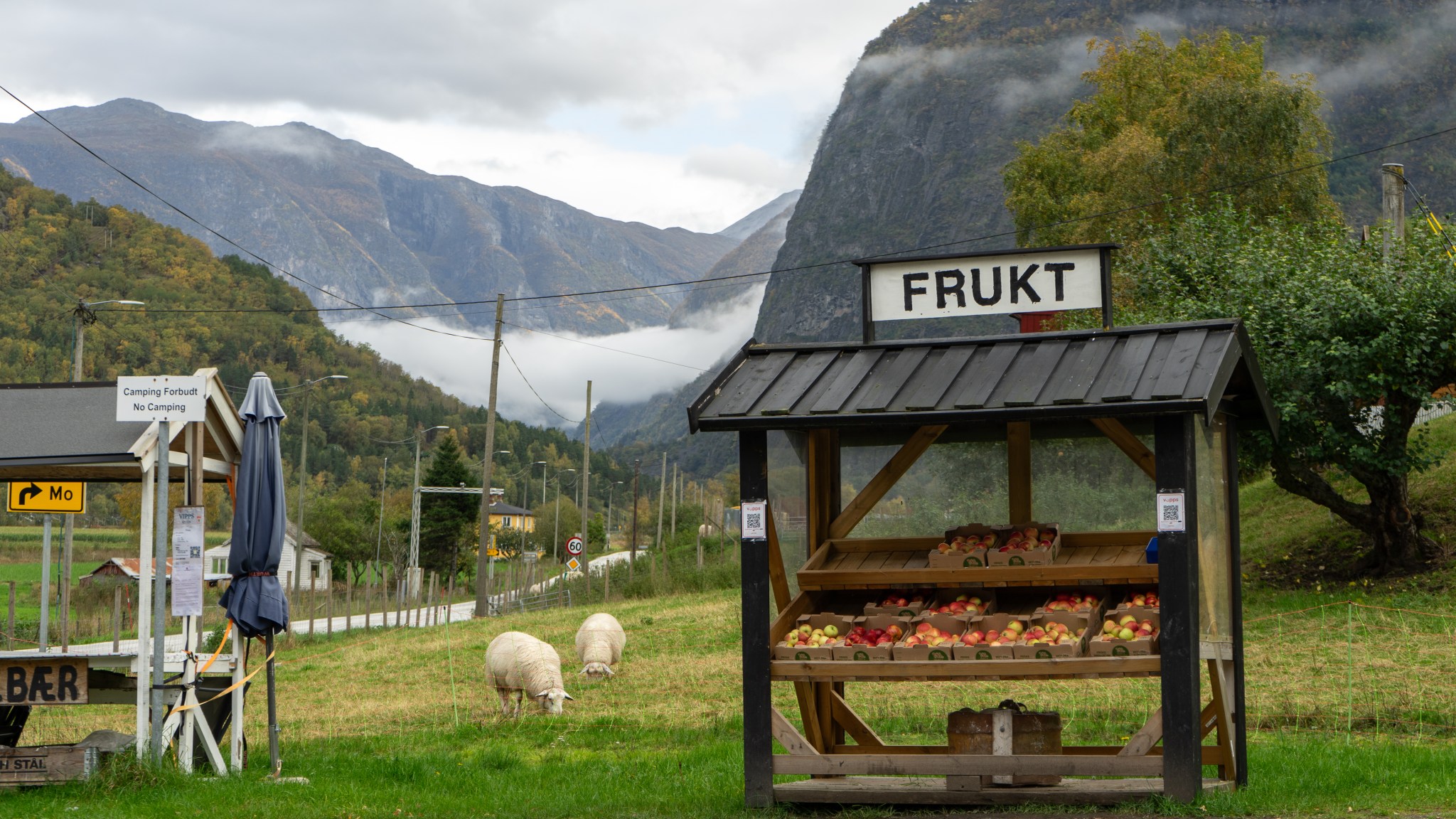
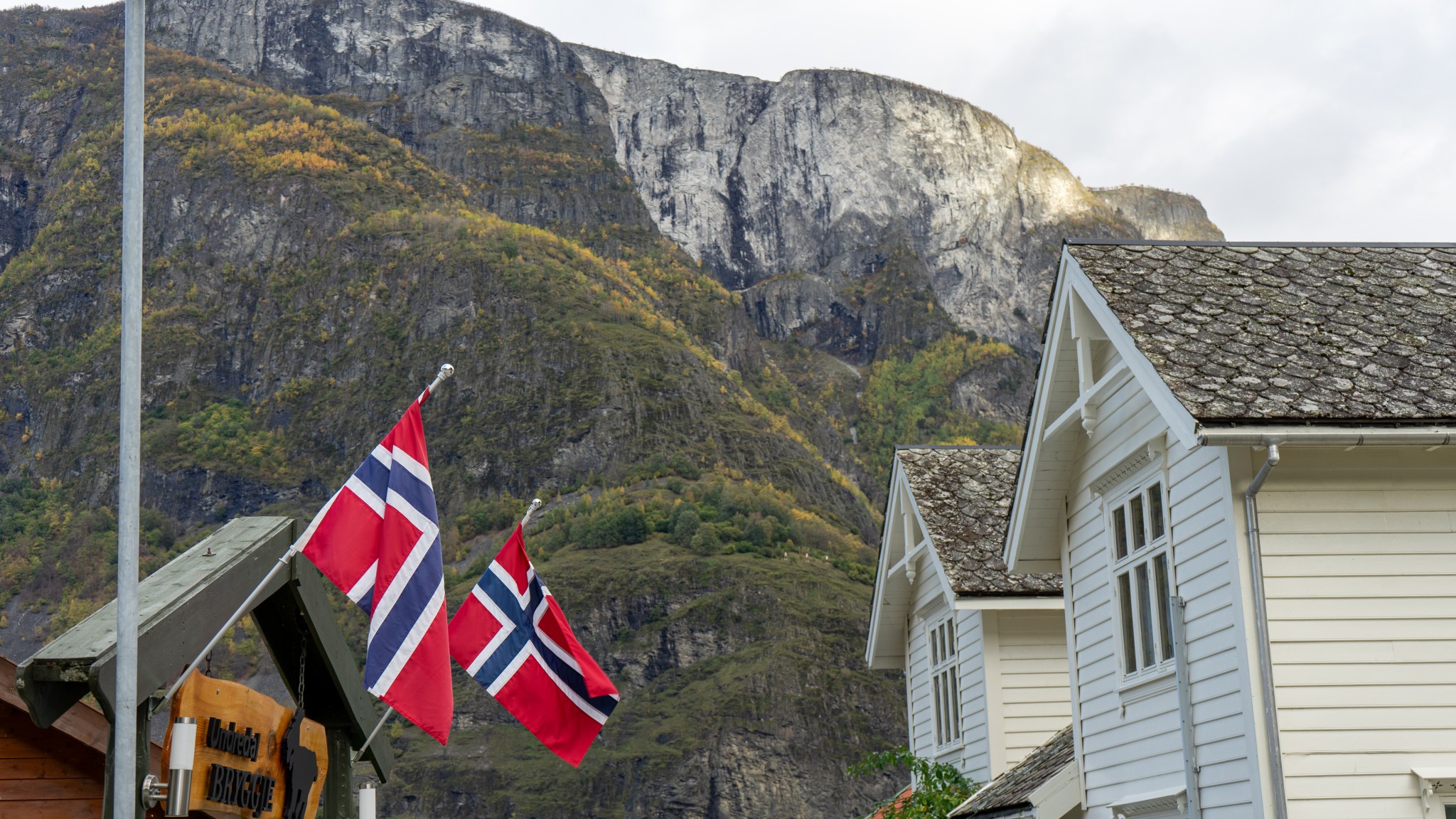
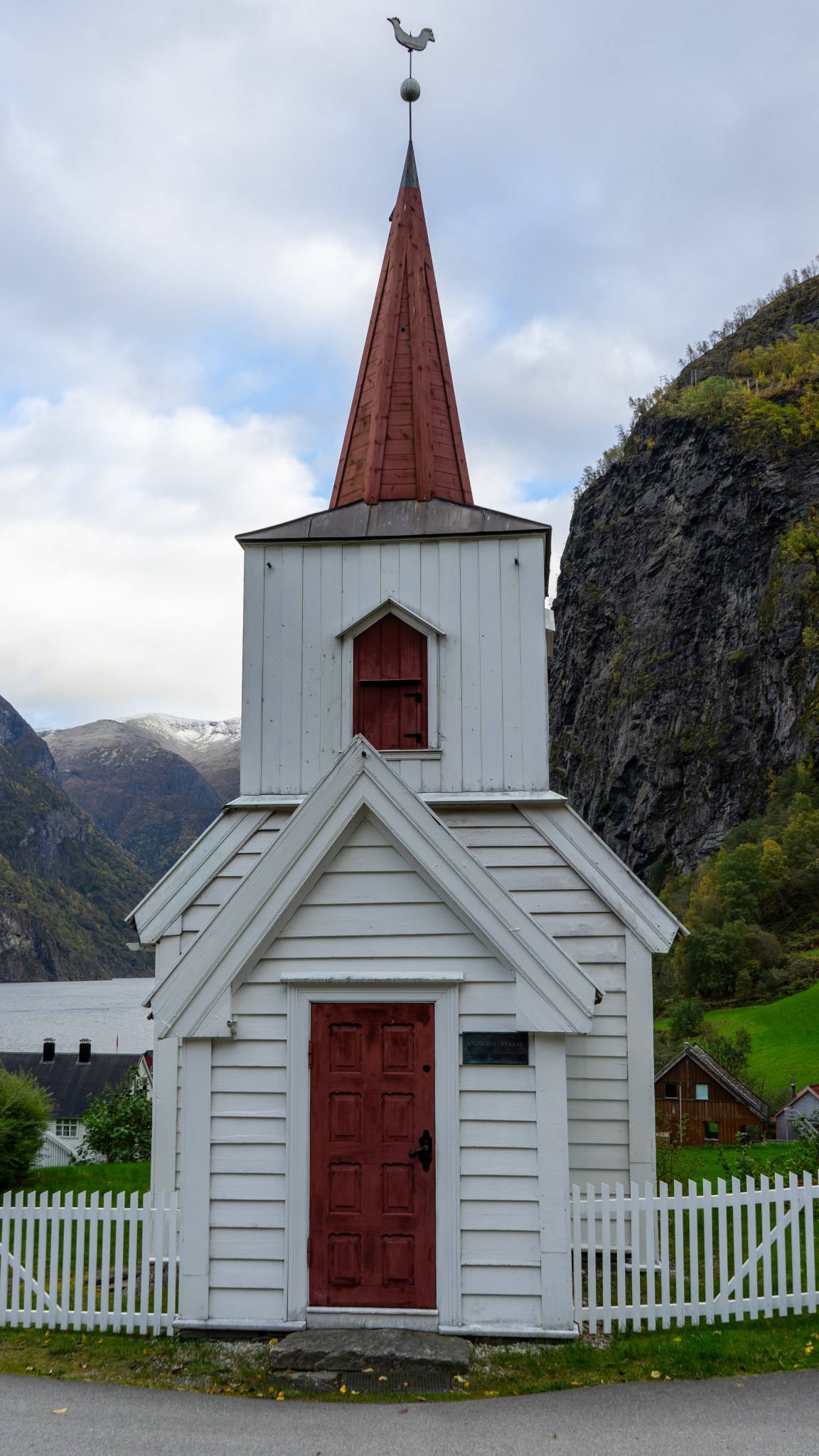
We took the E16 highway toward Oslo and followed it all the way to Undredal, a sleepy, and I mean Sleeping Beauty level sleepy town just outside of Flåm. The main attraction here, perhaps aside from its delicious brown cheese, is the Undredal stavkirke (pronounced “stahv cheerkeh”). Stavkirker, or stave churches, are a unique bit of heritage that, sadly, only Norway has inherited in the modern era. Northern Europe used to be filled with these medieval wooden structures. Norway alone had over 1,000 but today only 28 survive in varying degrees of preservation. Technically, there is one in Sweden, damn Swedes, but this one was built much later around 1500 AD so who cares? There is also a relocated Norwegian stave church in Poland, go Poles, which I was unaware of until writing this article.
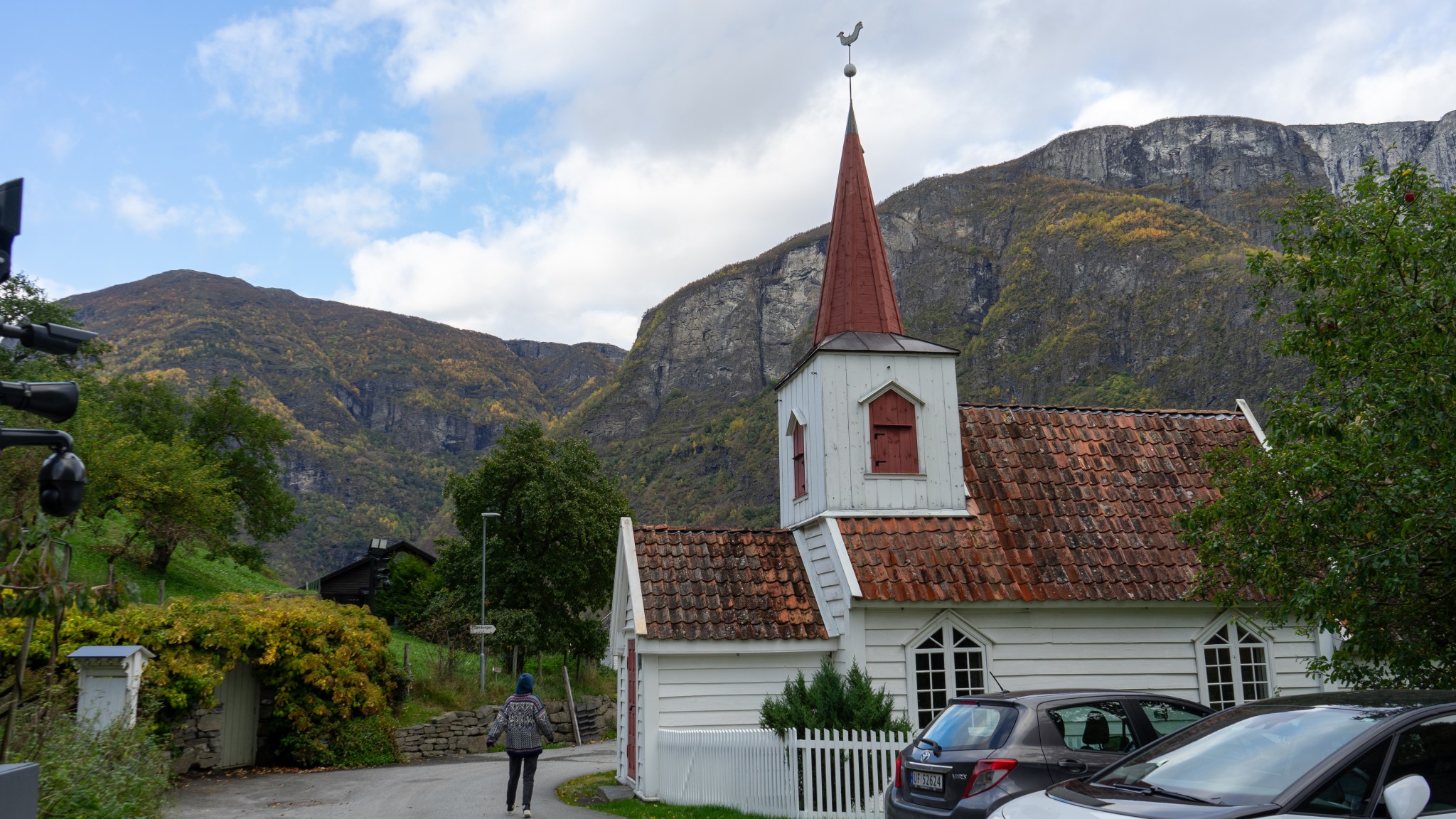
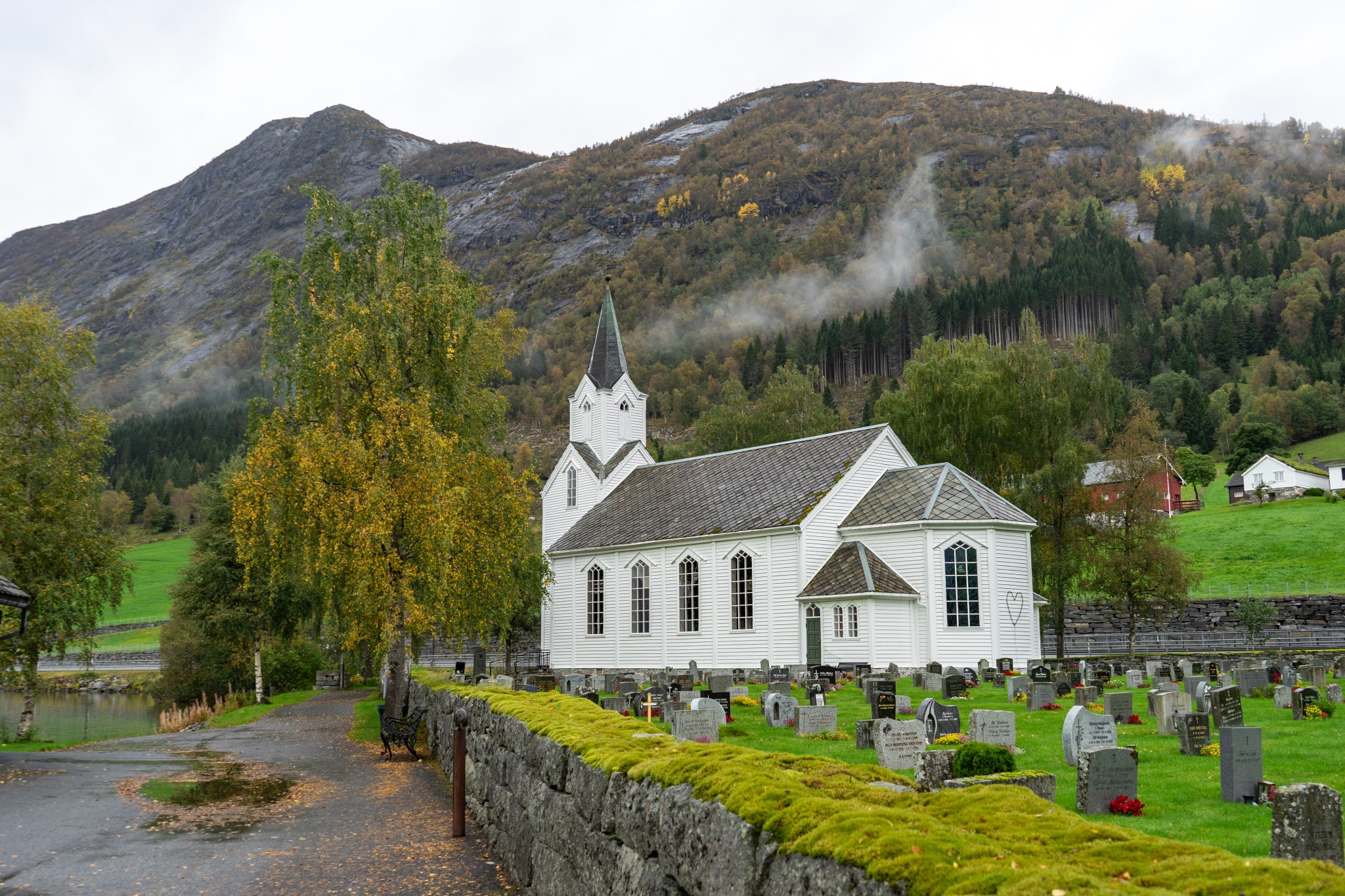
The Undredal church is actually not what most people in the know think of when they hear the word stavkirke. Unlike the more famous examples, such as Borgund, which we’ll get to in a moment, the Undredal church looks a bit more like an ordinary wooden church with white paint, a clearly delineated red steeple, and perhaps not so common terracotta roof tiles. As someone who has seen many stavekirker, however, I find the Undredal church to be unique and beautiful among its peers; a worthwhile stop on a drive east.
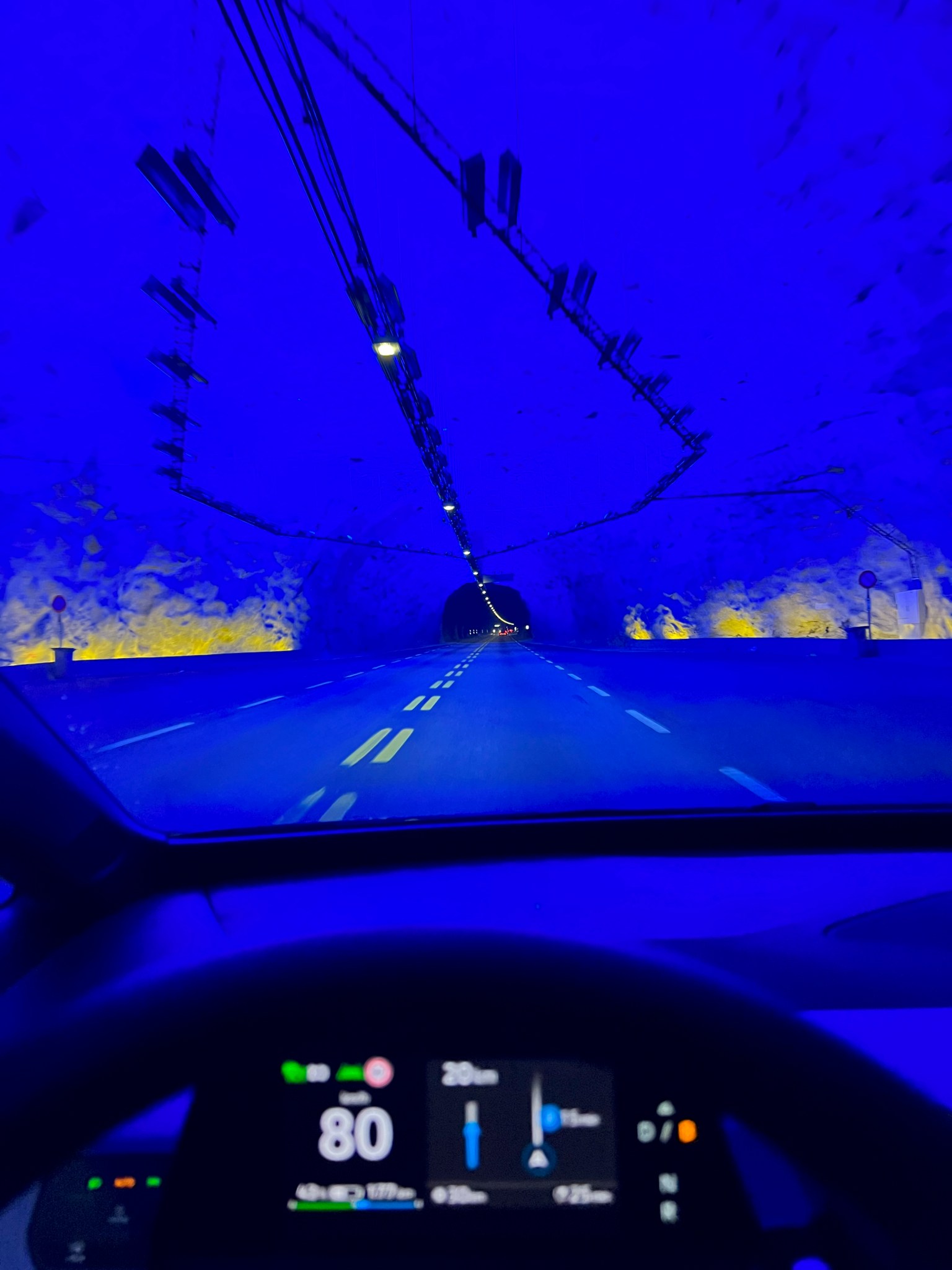
A relatively short drive farther east will take you through the Lærdal tunnel and on to Borgund. But the journey there is half the fun. Lærdaltunnelen is the longest tunnel in the world at 24.5km (over 15 miles) long. If I recall correctly, there were two “lightshow” sections, which I’ve been told are there to keep drivers from falling asleep or zoning out due to the extreme monotony of mile upon mile of tunnel lights zipping by their field of view.
It’s worth noting that while Norway offers some of the most spectacular drives, one does end up spending a significant amount of time underground. To help provide ease of movement and cut down on drive times in a mountainous country, the government has put that oil money to use carving deep into the earth building an impressive network of tunnels. It’s convenient, but not as pretty as the old roads and I’m reminded of a quote I heard somewhere: “The Dwarves dug too greedily and too deep. You know what they awoke in the darkness of Khazad-dum… shadow and flame..”
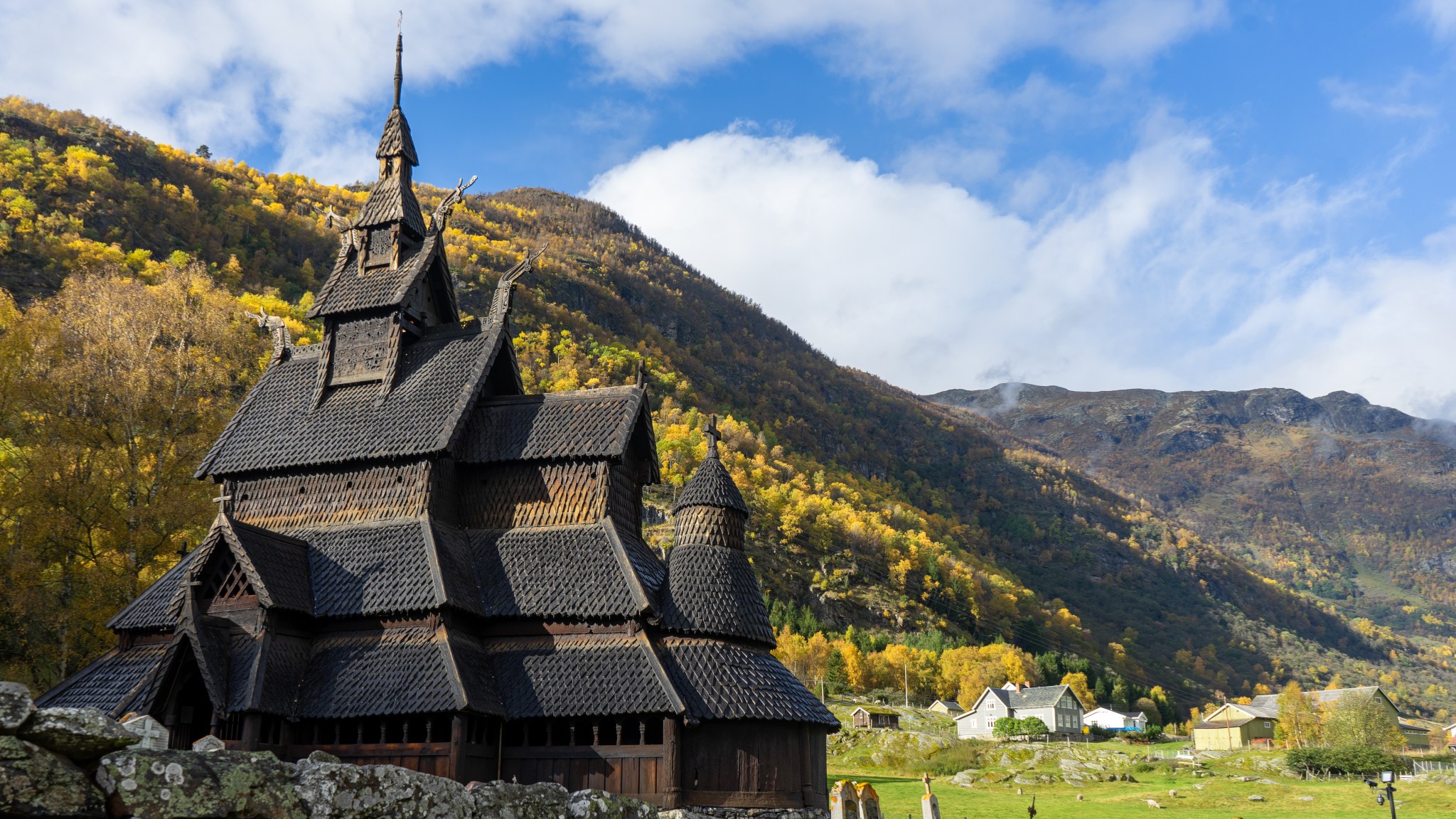
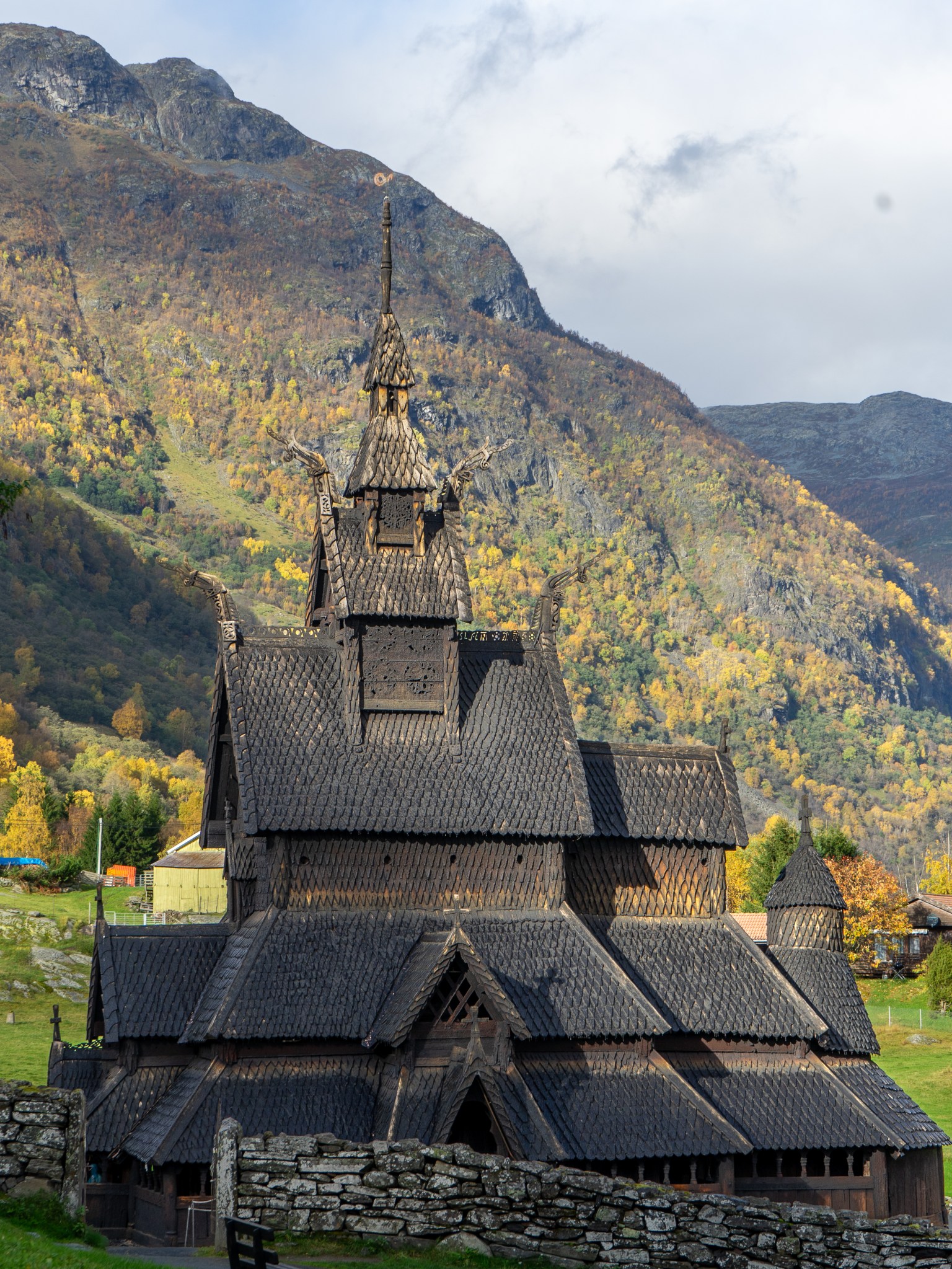
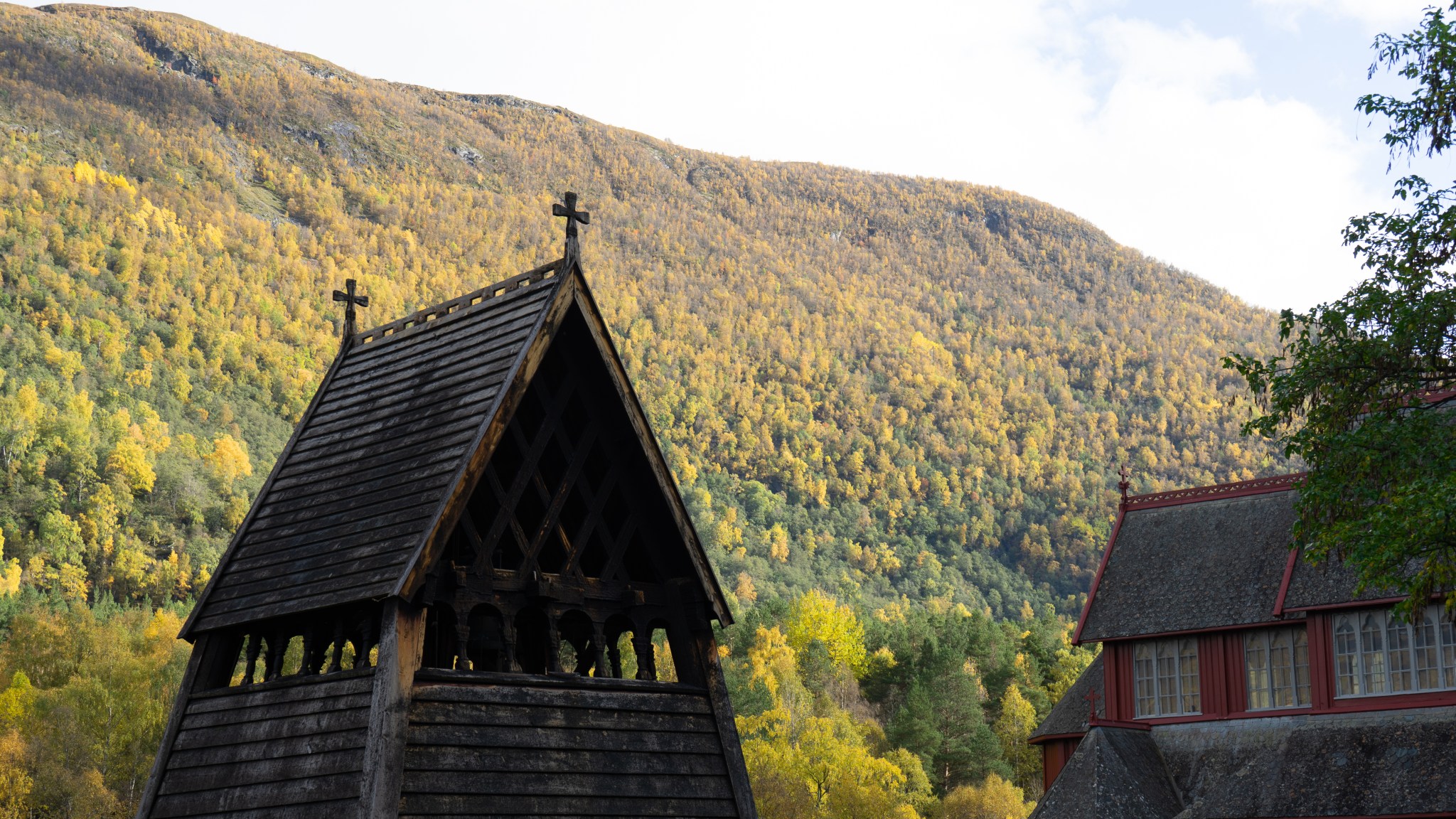
Regardless, the view at the end of the drive is well worth it. Borgund is the best preserved stavkirke in Norway and a much better example of the classic design. What both of these structures have in common is that, unlike the more ubiquitous (not to mention fire resistant) stone churches, stave churches are built out of wood and center around large wooden staves. Stave…church…..Stave church. See?
The Borgund church was built around 1180 and is dedicated to St. Andrew. This was during the Christianization of Norway and so one can find Christian as well as Pagan features in the woodwork. For instance, the roof is adorned with crosses alongside ornate dragon heads, a common Norse Pagan symbol, that act as gargoyles warding off evil. These are reminiscent of the carved dragon heads on the ends of Viking ships and it’s likely that the original architects were ship builders themselves, simply repurposing their skills to build churches. Some historians have even speculated that the Norse Pagan temples were essentially the same design as the churches only filled with icons of Thor, Odin, Freya, etc. Unfortunately, no examples of these exist today and we are left to speculate. Make sure to visit the guest center/museum to learn all about the history of the church.
As someone who is obsessed with history and human culture/religion, I find the stave churches and their religious syncretism to be fascinating. They’re wooden screenshots of a pivotal moment in Norwegian history when my fierce, heartless, and bloodthirsty Viking warrior ancestors were made meek, weak, and compassionate by Jesus. Just kidding; we Norwegians continued to murder innocent people, most of them Christians, long after we accepted Christ into our cold, unfeeling hearts.
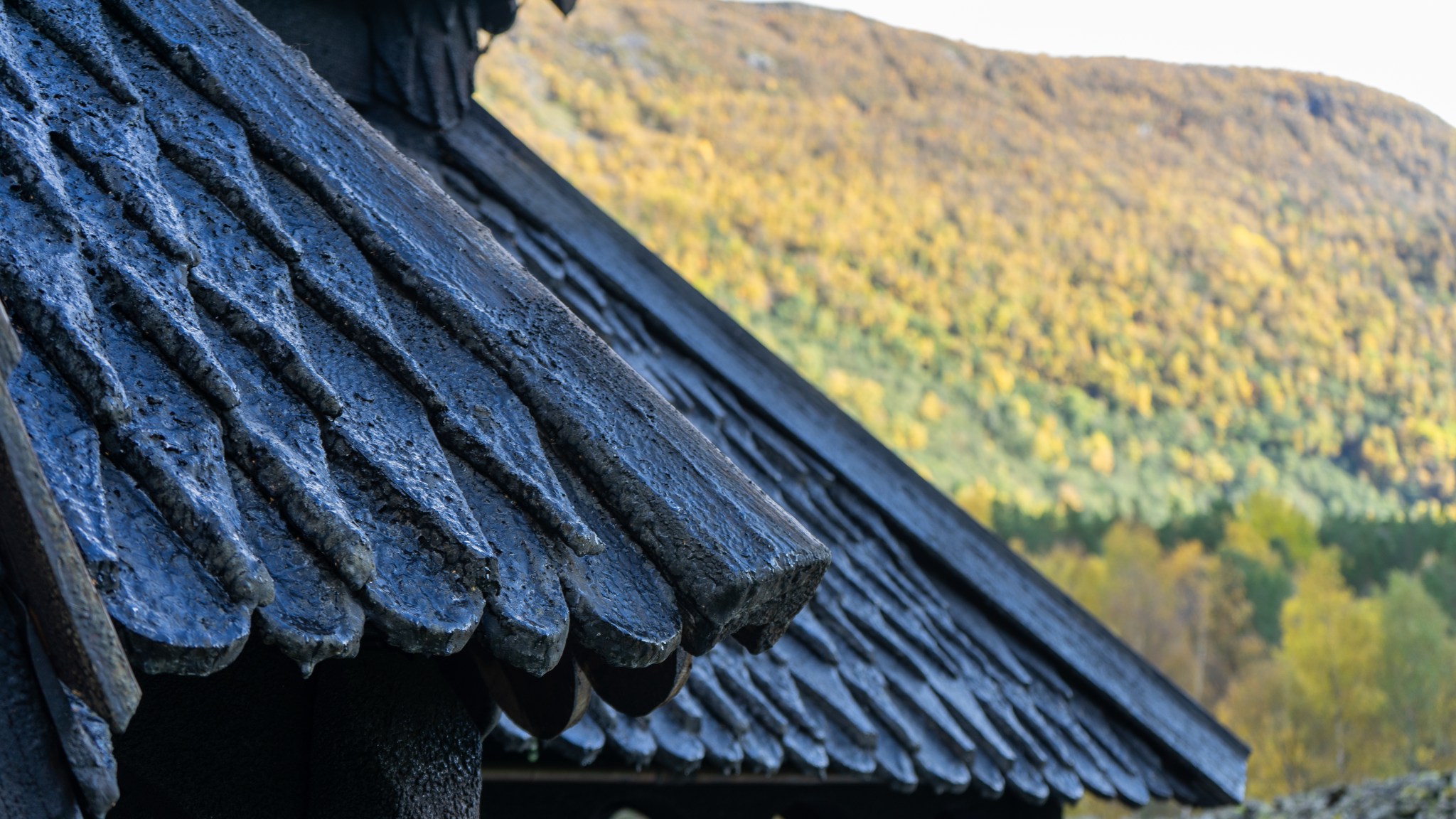
My girlfriend described the Borgund church as evil. I suppose it does have an evil look to it but that largely comes from the dark sap that was and still is applied to the wood exterior in order to maintain it. It’s incredible that even 28 of these medieval wooden structures stand today. Sure, some have been essentially rebuilt, but the Borgund is (almost) all (so not really all) original baby.
To infinity and By Flåm
So I called Flåm a by (prounounced “bee”), which means city in Norwegian, simply so that I could make a pun, but Flåm is far from a city. Though it feels less sleepy than Undredal, probably as a result of its tourism industry, it too can be hauntingly quiet when the cruise ships aren’t docked. The town is famous for being the terminal station of one of the steepest railways in the world, the Flåm Railway, which offers stunning views of the surrounding mountains as well as a glimpse of the elusive Huldra, that wicked temptress who lures “just normal…innocent men” to their doom. And yes there really is a lady who dances next to a waterfall and sings her allegedly sultry song as a part of the tour. A bit gimmicky but 13 year old me absolutely loved it. Sure, Norway is famous for being progressive, but did you really think our Viking ancestors wouldn’t have their own siren myth?
The town, situated at the end of Aurlandsfjorden (an offshoot of Nærøyfjorden) , is also at the bottom of Rallarvegen, an 82 km (50 mi) bike path that winds through the mountains. If you’re a masochist you can start from Flåm and zigzag your way up the mountain. I’ve done the trip twice but from the other direction because I love myself. This time around, however, Flåm was just a place to spend the night and get some rest before the morning hike. If you only have one night, I highly recommend going to the only restaurant in the town, Ægir Brewery. Unlike the other restaurants and bars in Flåm, Ægir actually exists and offers delicious food alongside an impressive selection of in-house beers. It’s a bit sublime walking down the completely deserted, silent streets at night to then enter the bustling, warm, and yes koselig brewery. The fact that the outside is cold and empty makes the refuge of Ægir that much more surreal and welcome. Something out of a a Norse eventyr (fairy tale).
That serene yet eerie silence out on the streets can disappear overnight when a cruise ship shows up. It’s startling to awake in the morning and look out your hostel window only to see that a brand new massive apartment building has appeared in the harbor. The population of the tiny town swells as thousands of tourists disembark from their floating metropolis. Most quickly re-embark on to another, albeit smaller, day-cruise ship to take in the postcard sights of Aurlandsfjorden. It’s one way to avoid sea legs.
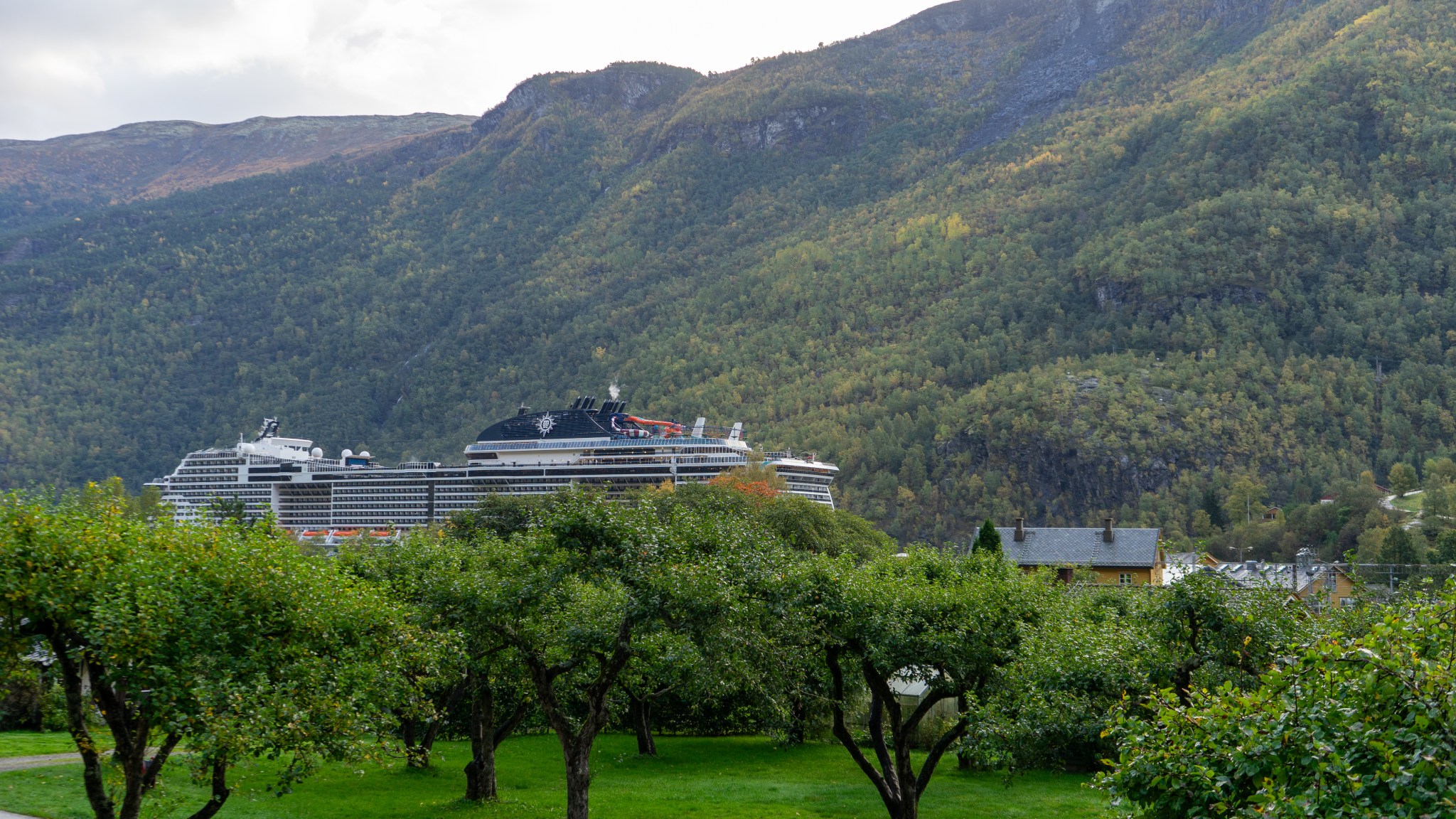
To Aurlandsvangen and up the mountain
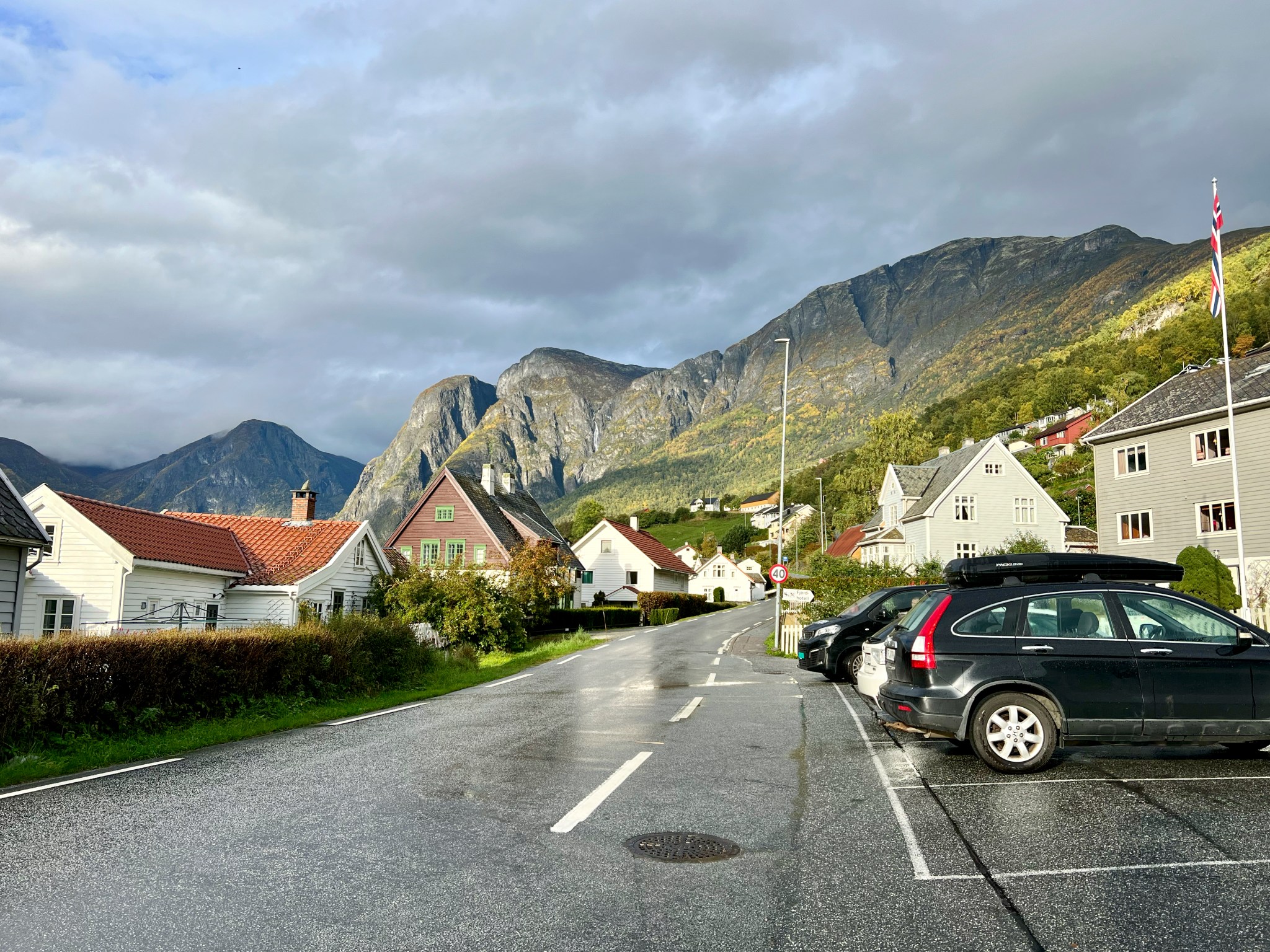
While there are plenty of adventures to be had beginning in Flåm as mentioned before, I found the neighboring town of Aurlandsvangen to be much more charming. A ten to fifteen minute drive down the road, Aurlandsvangen is more of a real Norwegian town. Instead of the majority of the population consisting of day trip tourists and seasonal workers like Flåm, the town seems to be inhabited by people who actually live there.
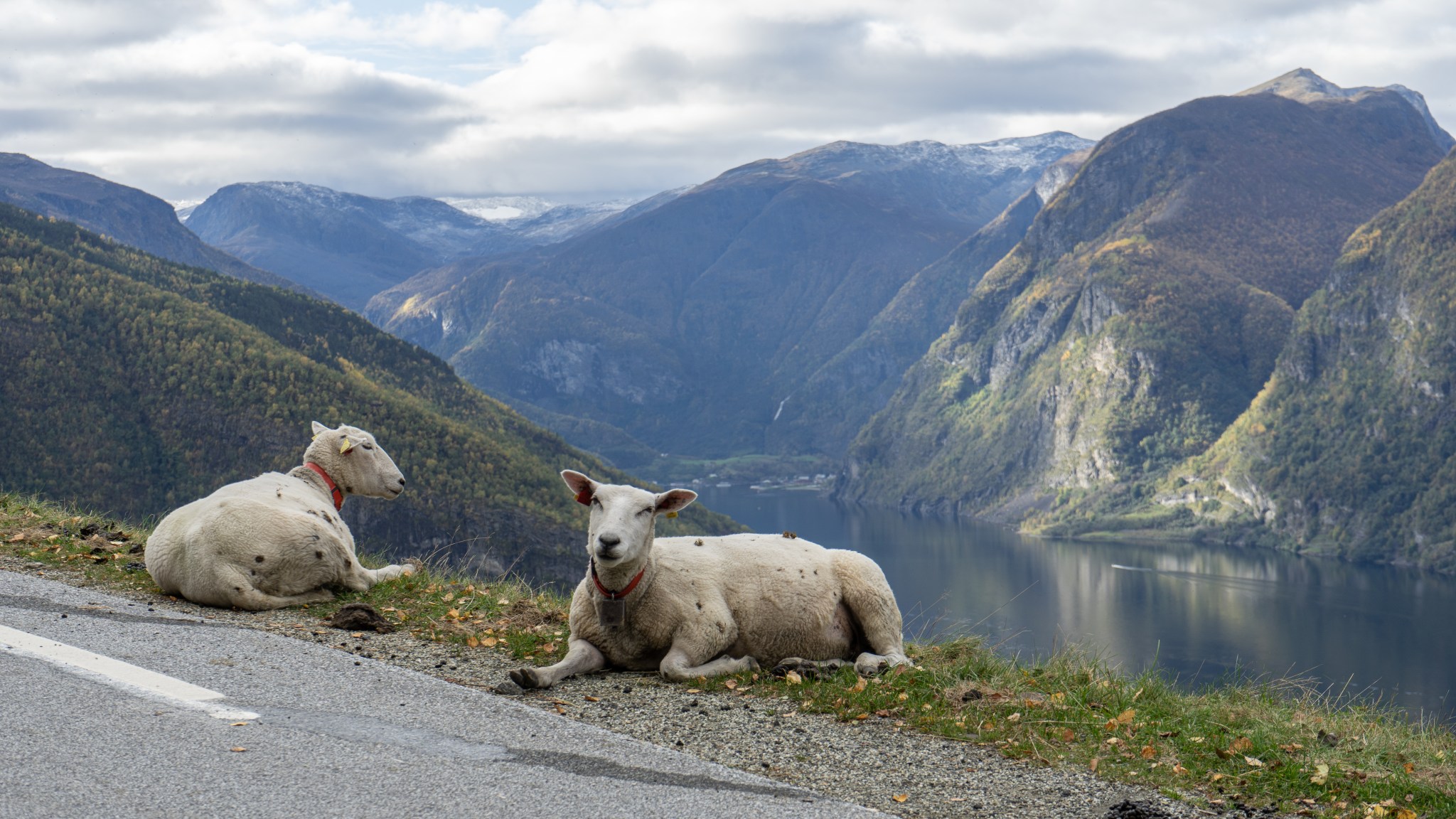
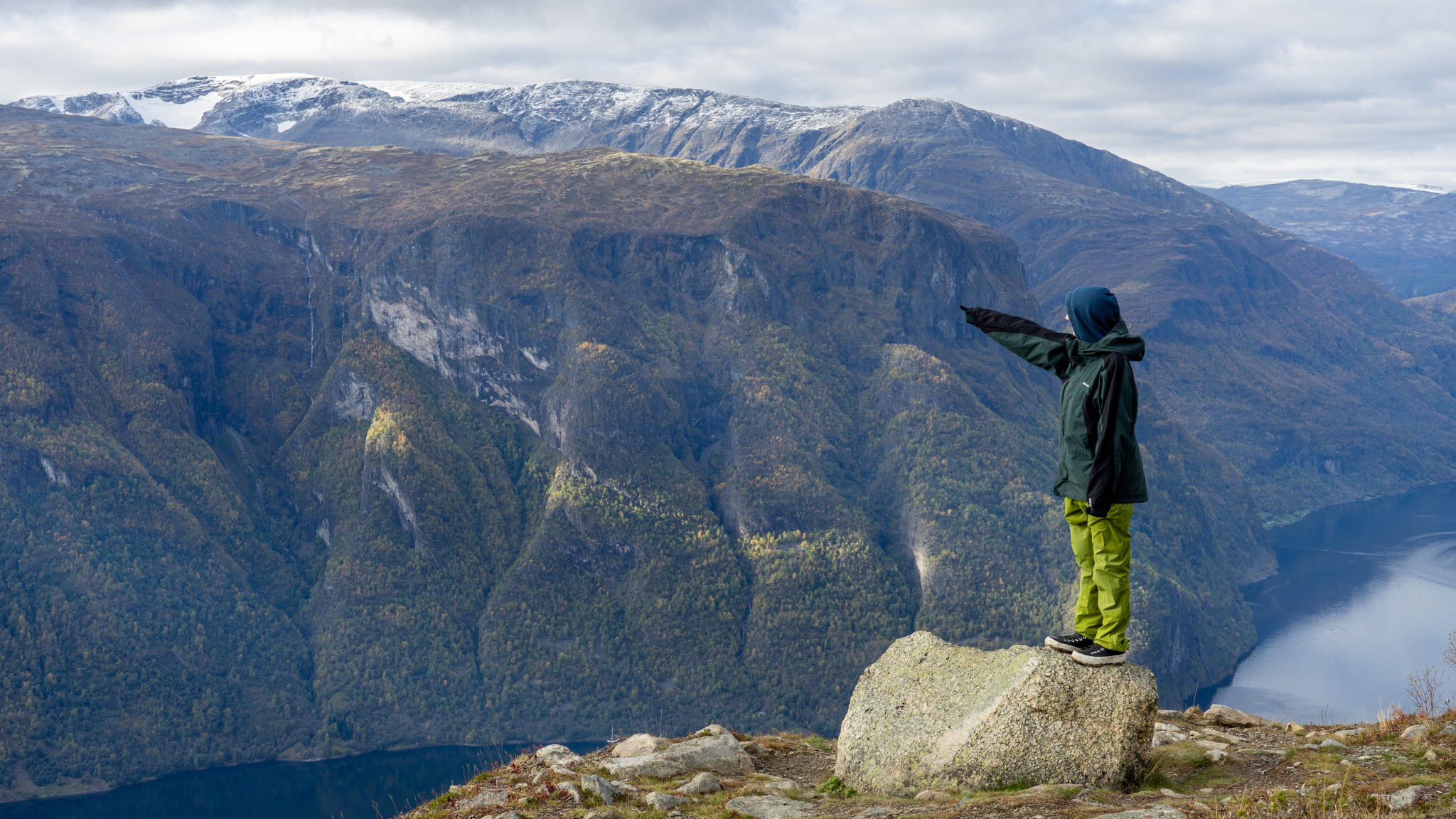
One reason I went back to Aurlandsvangen (remember I’d already visited this area alone) was to finally conquer Prest, a challenging hike that takes you high up the cliffs above the fjord. I turned back last time when it began to rain heavily (can you believe it??) as I didn’t think it wise to climb up the steep face alone on the wet rocks.
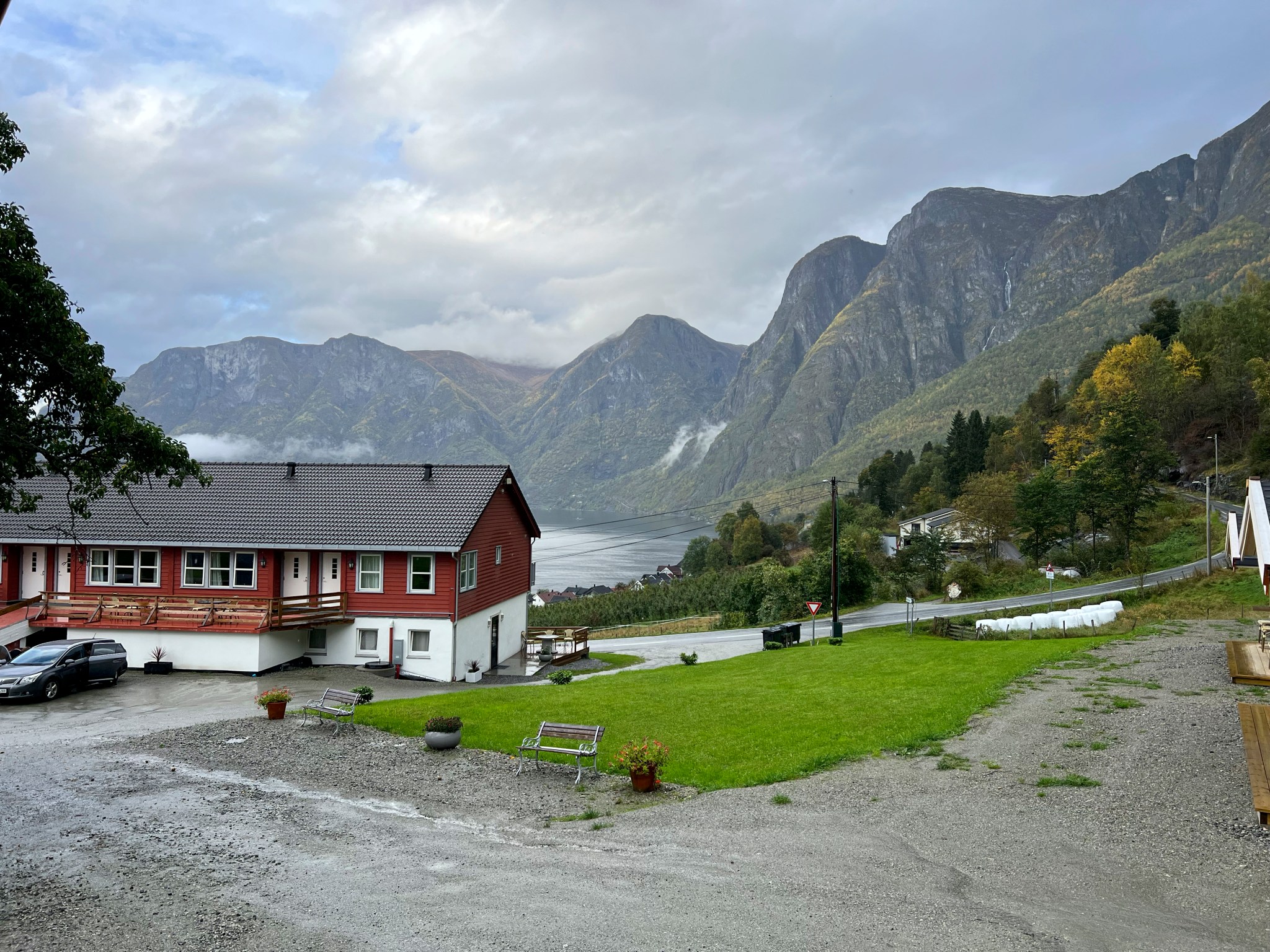
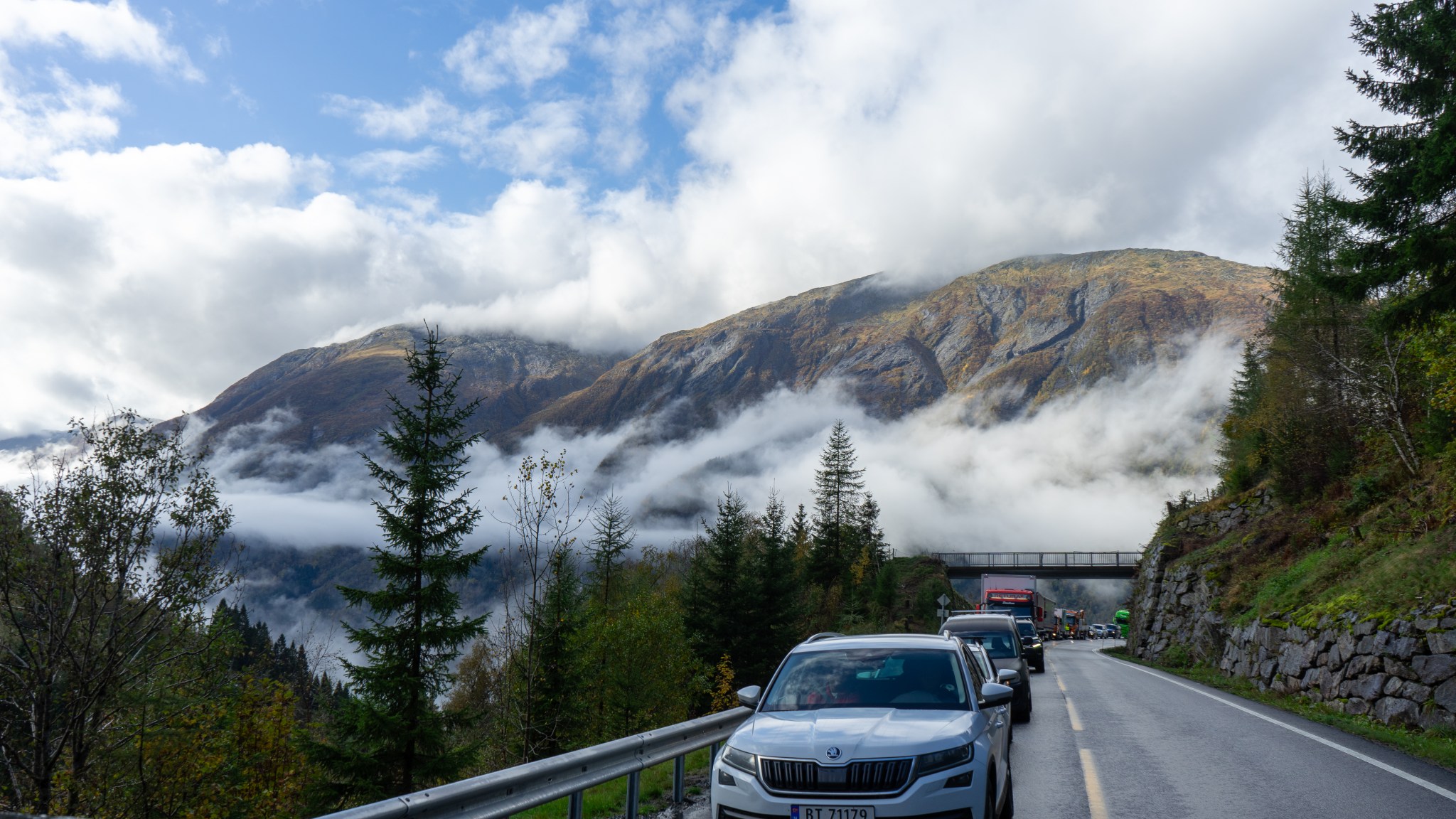
The drive up to the start of the Prest trail is enough to make the trip worth it. Zigzagging back and forth in my ID3, dodging busses, cars, and sheep on the narrow roads barely fit for even one car (in my Southern Californian view), I was struck by the quintessential Norwegian scenery. Pictures really don’t do it justice. In fact pictures never seem to do Norway justice. It’s impossible, at least for this amateur photographer, to capture the vastness and the steepness of the terrain.
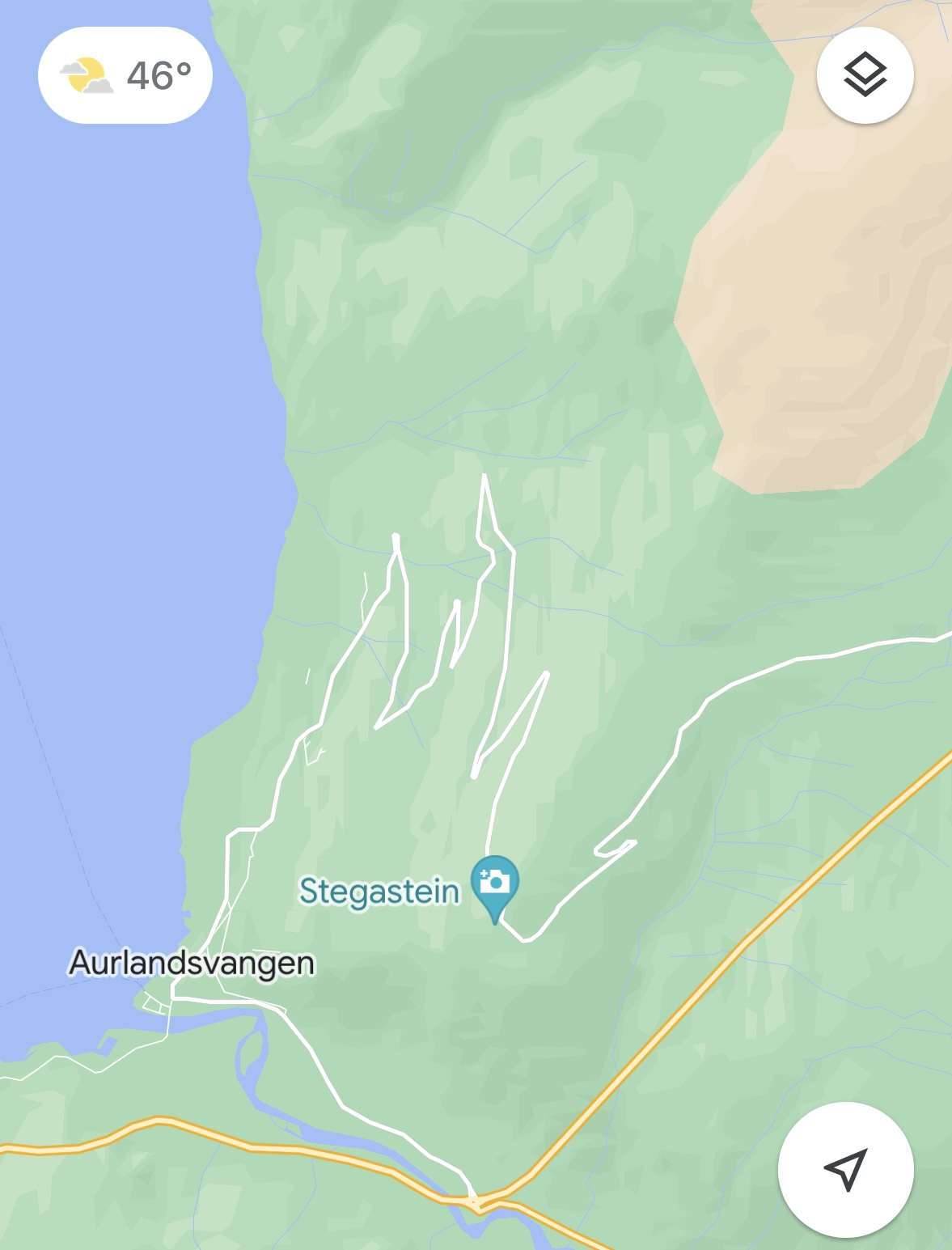
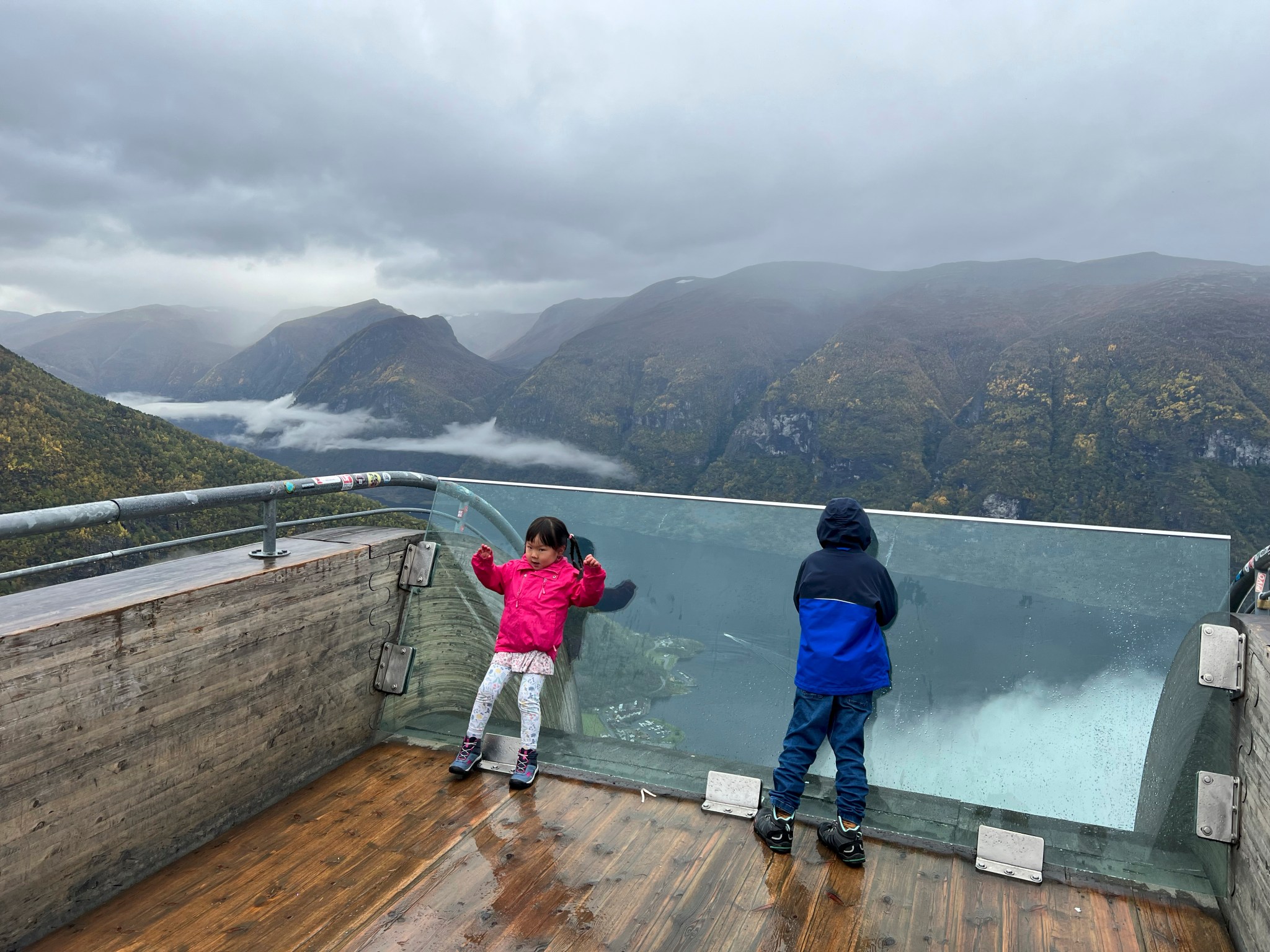
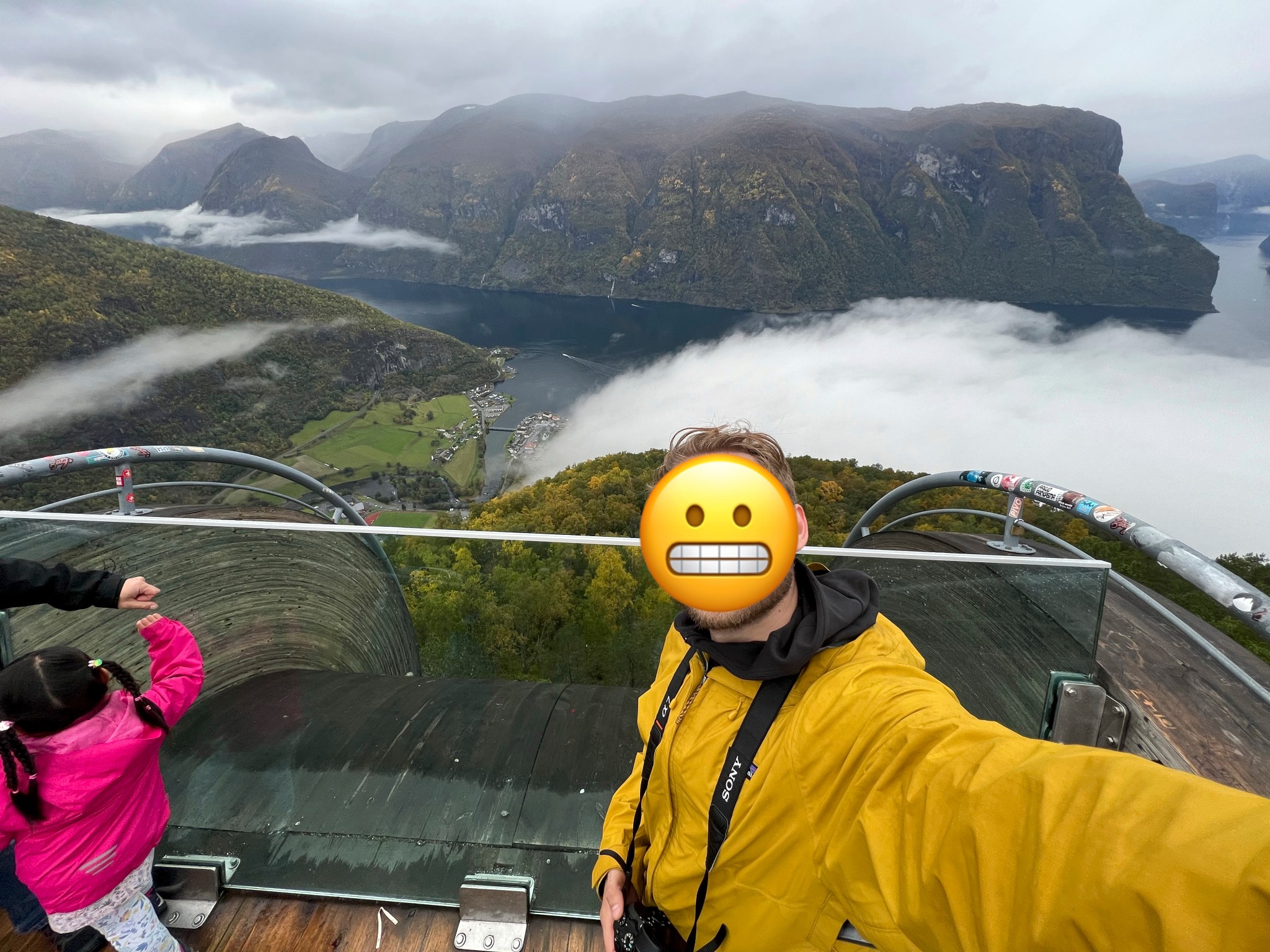
When the road finally stops its undulating pattern back and forth across the mountain face and heads straight back into the valley, one can take a stop at the Stegastein viewpoint to take more unsatisfactory photos. While it doesn’t offer quite as impressive views as the climb to Prest, it’s a great destination if you’re not in the mood for a hike. Much like the drive up, Stegastein isn’t the best for those afraid of heights.
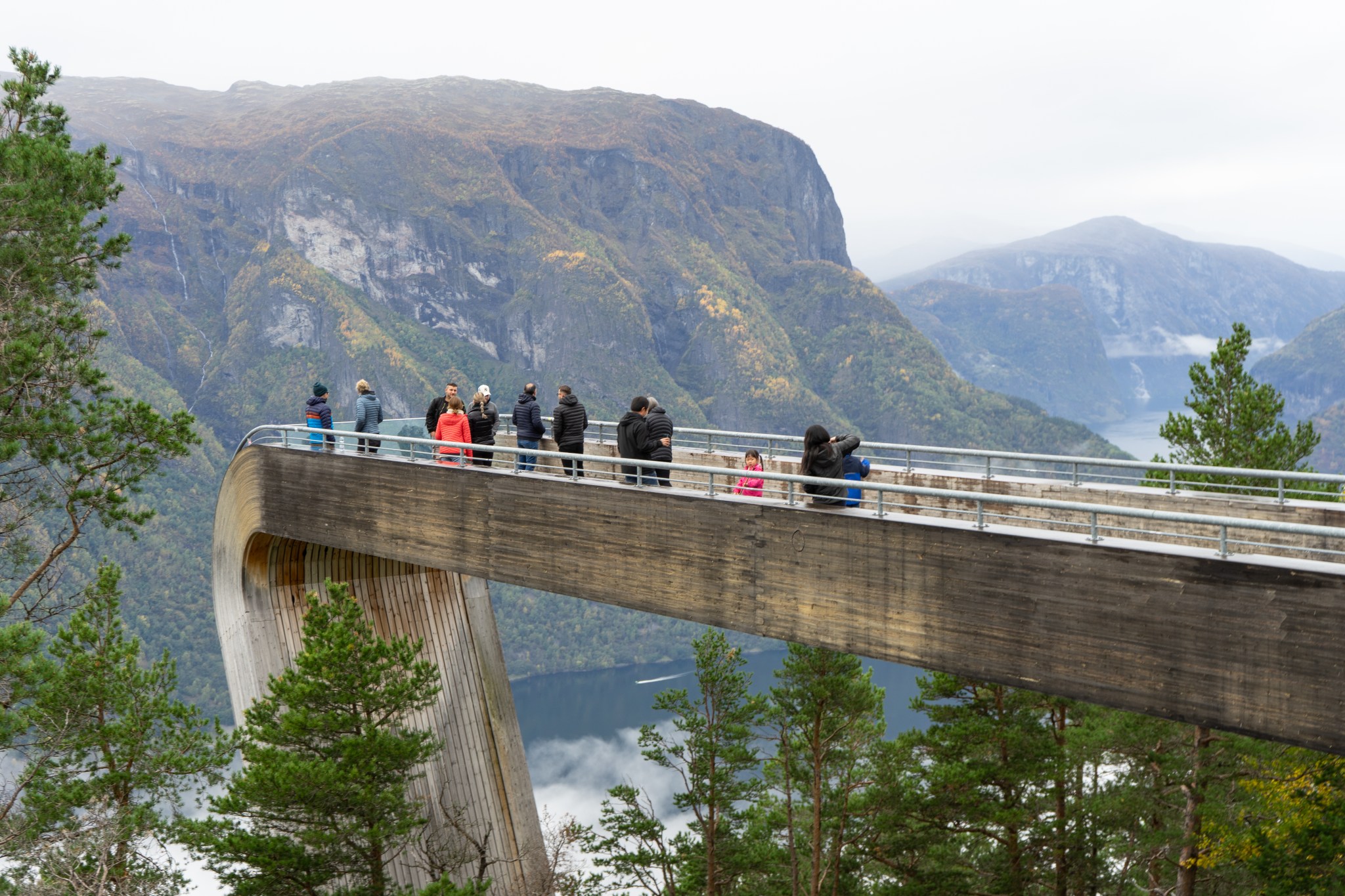
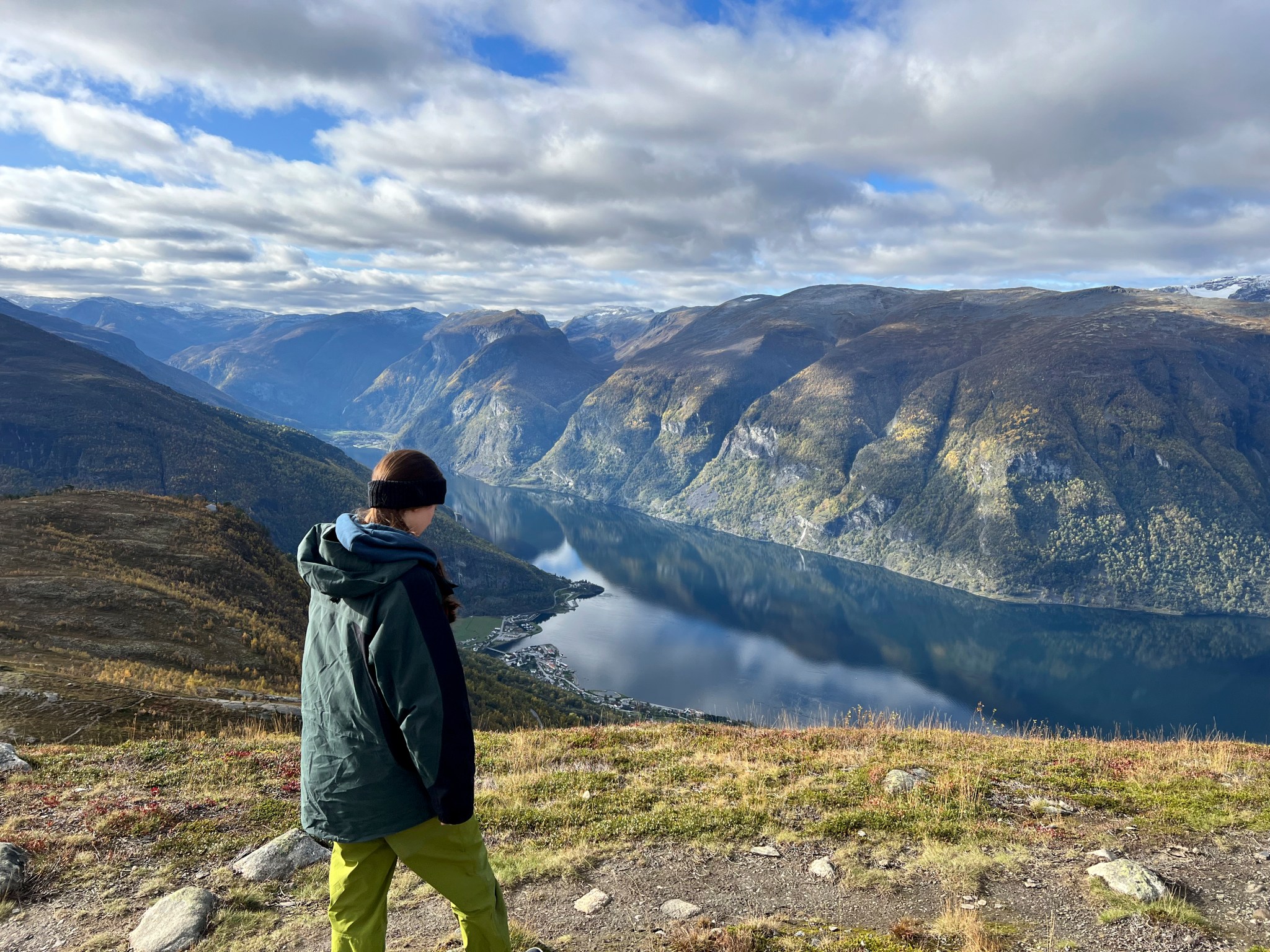
Continuing the drive back into the valley a few more minutes you will come to the trailhead for Prest. AllTrails rates this hike “hard” and at a length of 4.5 km (2.8 mi) with an elevation gain of 547 m (1794 ft) it certainly isn’t easy. For you layfolk out there like me, that’s a lot of elevations in not that many distances; it’s steep. The good thing about it, as a friendly cafe employee back in town pointed out to me, is that it doesn’t matter where you stop if you aren’t able to finish the trail. Because it already begins halfway up the mountain, the trail offers spectacular views of the valley to one side and the fjord to the other all the way along the route. Had too many delicious beers at Ægir the night before (don’t do that)? No problem, just do the first third of the hike and take in the beauty from “only” 1300 meters up.
Part of what’s so striking about these mountains is that, while they’re only a couple thousand meters above sea level, that sea is right there at their feet. Remember, fjords are deep inlets from the ocean. So while 4,000 meters might not sound like a lot for a peak in the Rockies, it’s 4,000 meters in elevation gain from the sea level town below and almost straight down. Again, not for those who are squeamish around heights.
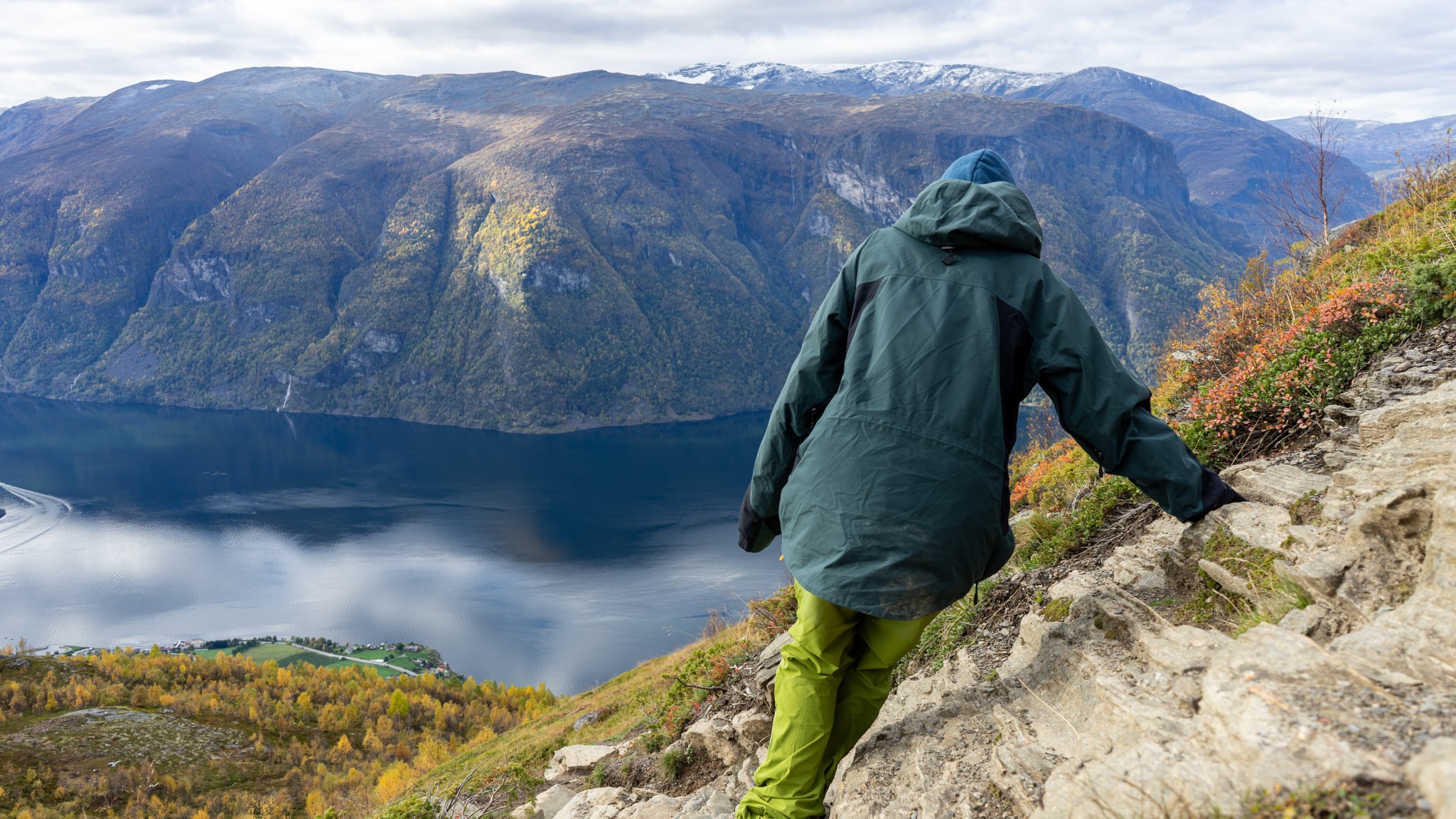
Unfortunately, the climb proved too steep for my beloved girlfriend. Yes I’m blaming the woman. Who am I, the ancient Norwegian who authored the Huldra myth??? We made it to almost the exact spot where I turned around last time (can’t blame her for that one, damn), but like I said before, the ascent can be abandoned at any time and it is still worth each step. I still have yet to truly test that claim, admittedly. Perhaps next time I’ll make it to the top of Prest and let you know.
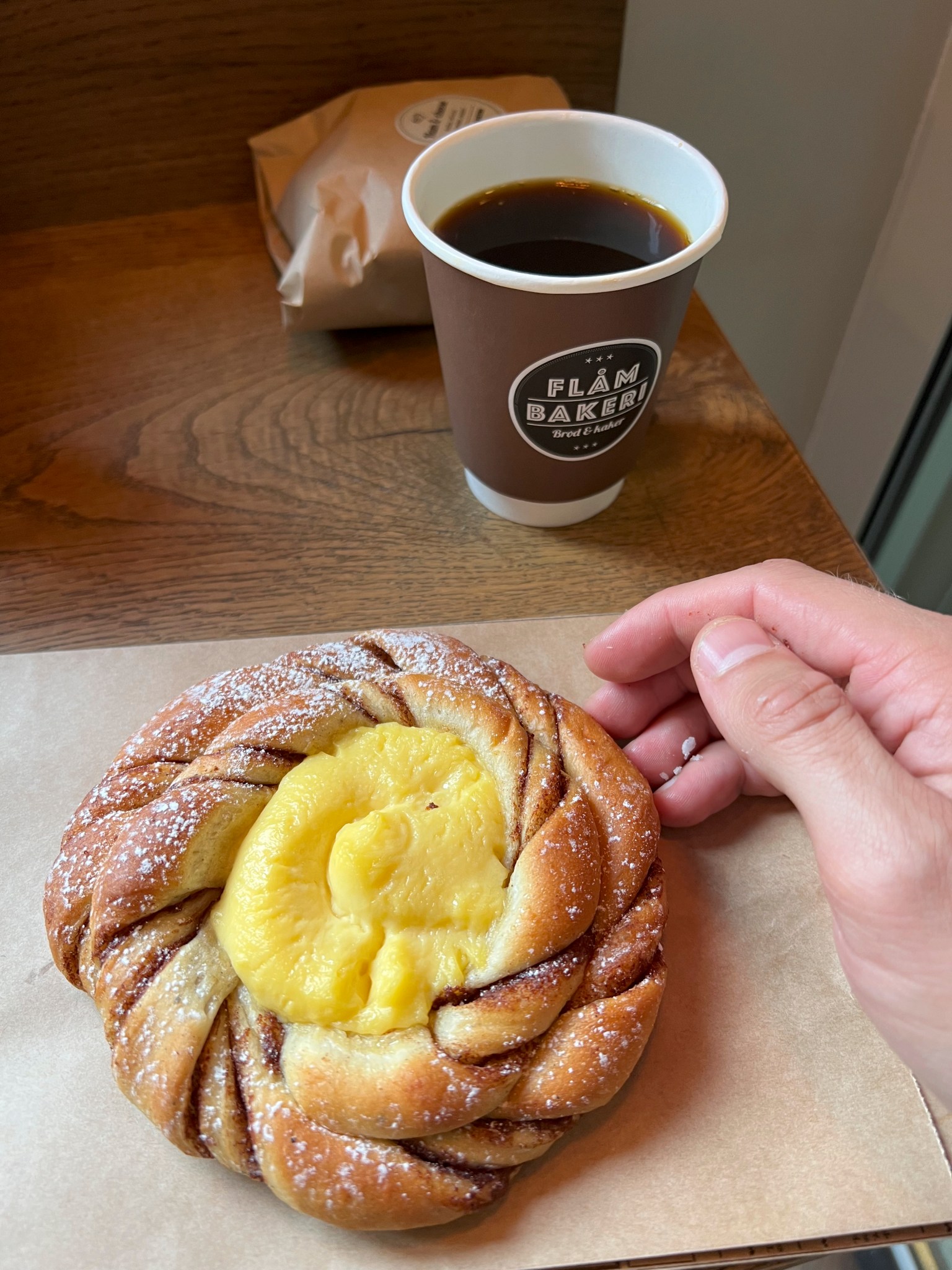
After the climb it’s important to refuel with some caffeinated coffee and refatten with some calorie-laden pastries at Marianne Bakeri & Kafe. The cafe sits nestled right where the Aurland River empties into the Aurland Fjord. With two balconies overlooking the meeting of two bodies of water, it’s the picture perfect place to enjoy a reward for your hard work. Norwegian pastries, like most European sweets, are usually not as sweet as their American counterparts. But the custard filling of a skolebolle is sweet enough for this Yank and it seems like most of the baked goods have a tasteful touch of black cardamom. We love black cardamom.
Voss and the return to Bergen
Sadly, we only had three days for the whole adventure east and it was time to start heading back. Fortunately, we had one more night to spend somewhere new, the world famous Voss! Well at least the bottled water brand, Voss, is world famous. My girlfriend and I were surprised that none of the grocery store shelves had any Voss water bottles, but after a quick Wikipedia search I can see that the brand is actually from Vatnestrøm. Why they trick us like that?
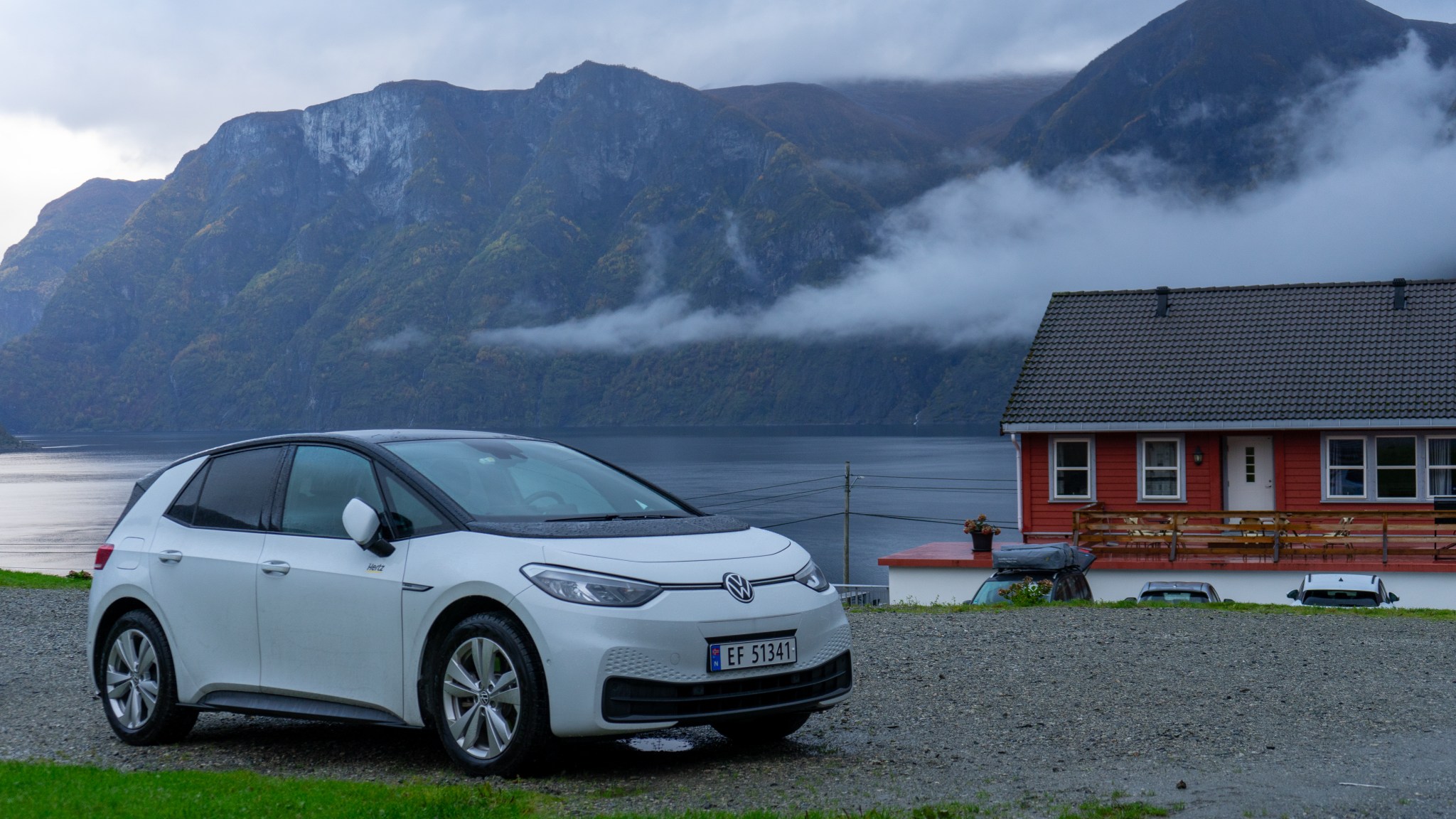
Ok, so perhaps Voss isn’t so famous after all, but it was the perfect medium-sized town to spend our last night in the area. While we’d spent the previous night in the perfectly suitable Flåm Hostel, we decided to go up a notch and stay in the historic Fleischer’s Hotel. The hotel alone seemed worth the stay in Voss with complimentary sauna, pool, and hot tub in the basement bathhouse. It’s also haunted by a friendly ghost, Mrs. Fleischer herself, which is an added bonus. We stopped by her favorite room, 407, but she wasn’t in a chatty mood so we moved along.
For dinner we headed to the only place open late, Inside Voss Rock Cafe. It was fun experiencing an ordinary night in a Norwegian town. Young guys who wouldn’t be allowed in an American bar playing pool, coworkers (several of them Italian actually) enjoying a night out after work, one super creepy guy ogling every single girl who entered, and the friendliest, coolest bartender I met in the whole country. He was a watch guy and showed me his Breitling diver (he actually dives) and he loved my vintage Grand Seiko (I actually check the time sometimes). He explained all the different aquavits to me and gave us a complimentary coffee to go with it. Burgers were delicious. All around great time.
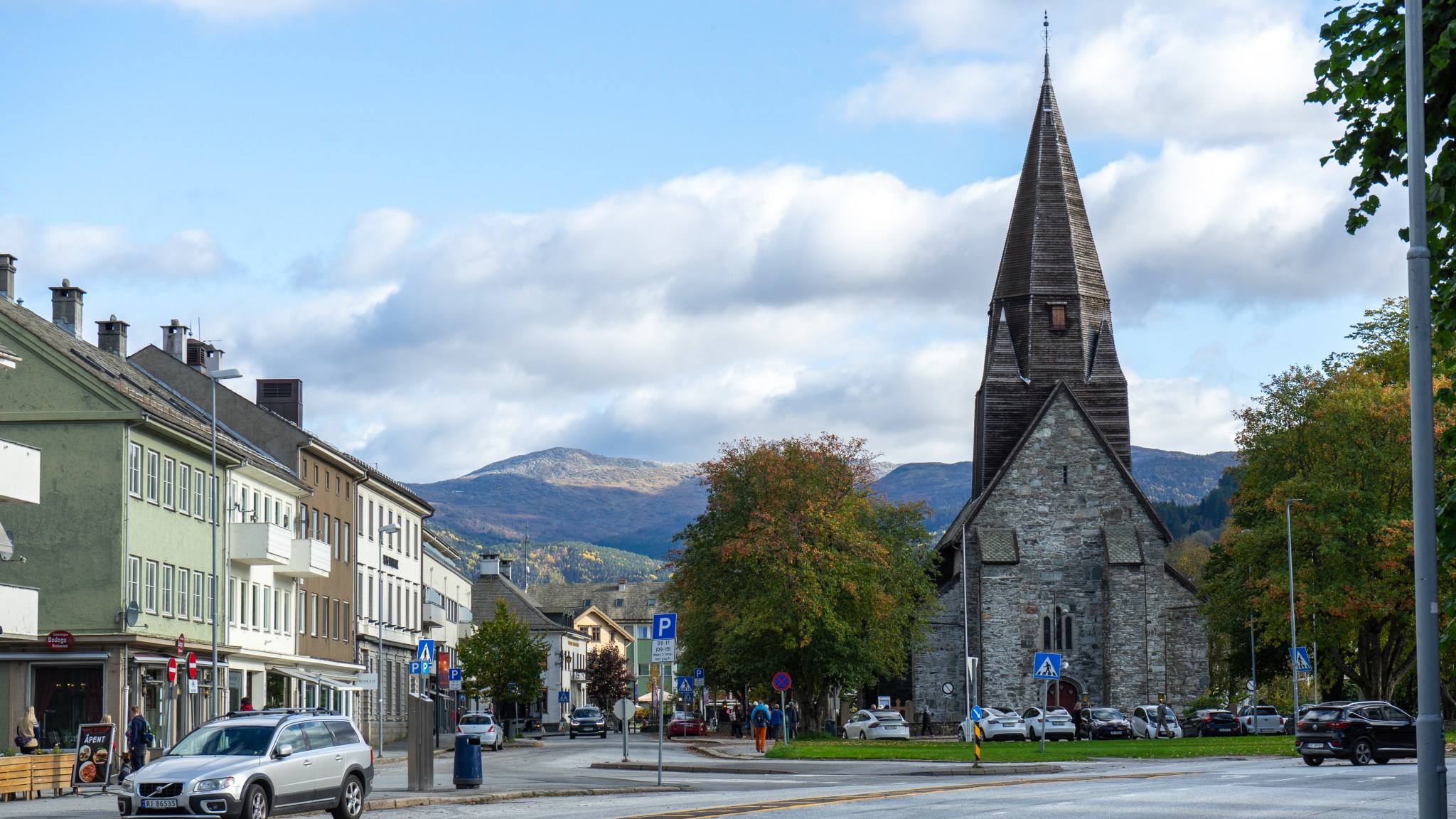
The next morning my girlfriend had school work to do so we stopped in a cafe with broken wifi to not get anything done. On to the local library for a much more satisfactory connection and another peak into ordinary Norwegian life. The library, situated right beside the large Voss Lake, is representative of the now actually world famous Scandinavian minimal design. Giant glass walls overlooking the water made for slightly distracting, but welcome views. To get the best view of the lake there is actually a gondola that takes you to the top of the mountain behind Voss, but apparently it’s closed on Mondays. It was Monday.
Sadly, our time had run out and we had to mosey on back to Bergen for one last bittersweet night with my cousin before departing the country altogether. It had been 6 years since I visited Norway, and after this trip, with my newfound ability to converse like a toddler in my own language, I won’t let that many years pass before returning. In fact, I might even return with my girlfriend next year if I’m able as we both had such an incredible time. Our trip together was far too short (5 full days) and we hope to explore much more next time. But if you, dear reader, are planning to visit Norway on a similarly tight schedule, I hope that this article might be of some use to you. It’s only one possible excursion from Bergen of many and I wouldn’t dissuade you from picking another route, as Norway is beautiful in just about every direction. But if I were to recommend a trip to a first time visitor to the area, I’d recommend this one.
Tusen takk, og god tur! (Thank you very much, and have a great trip!)
-G
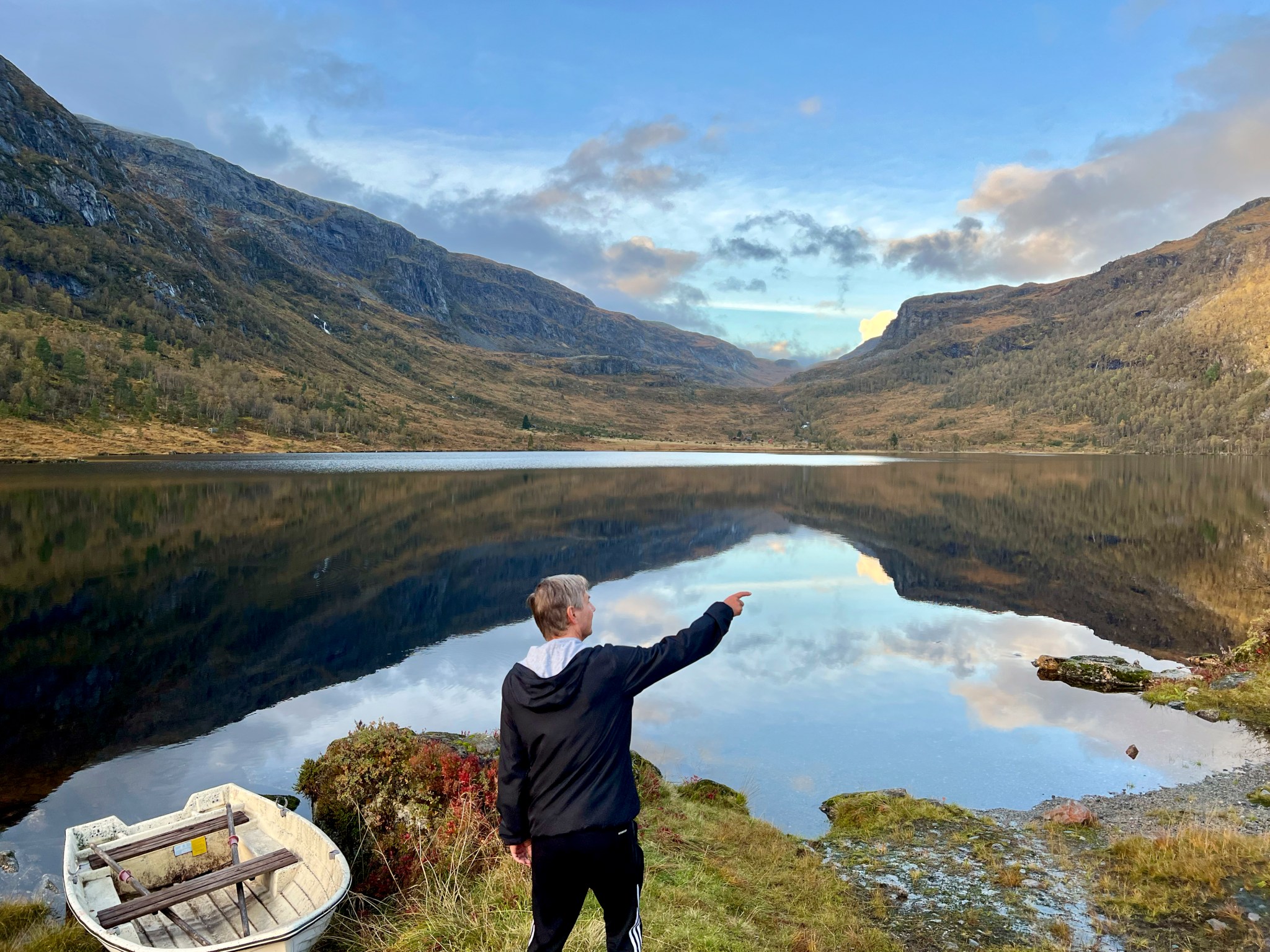
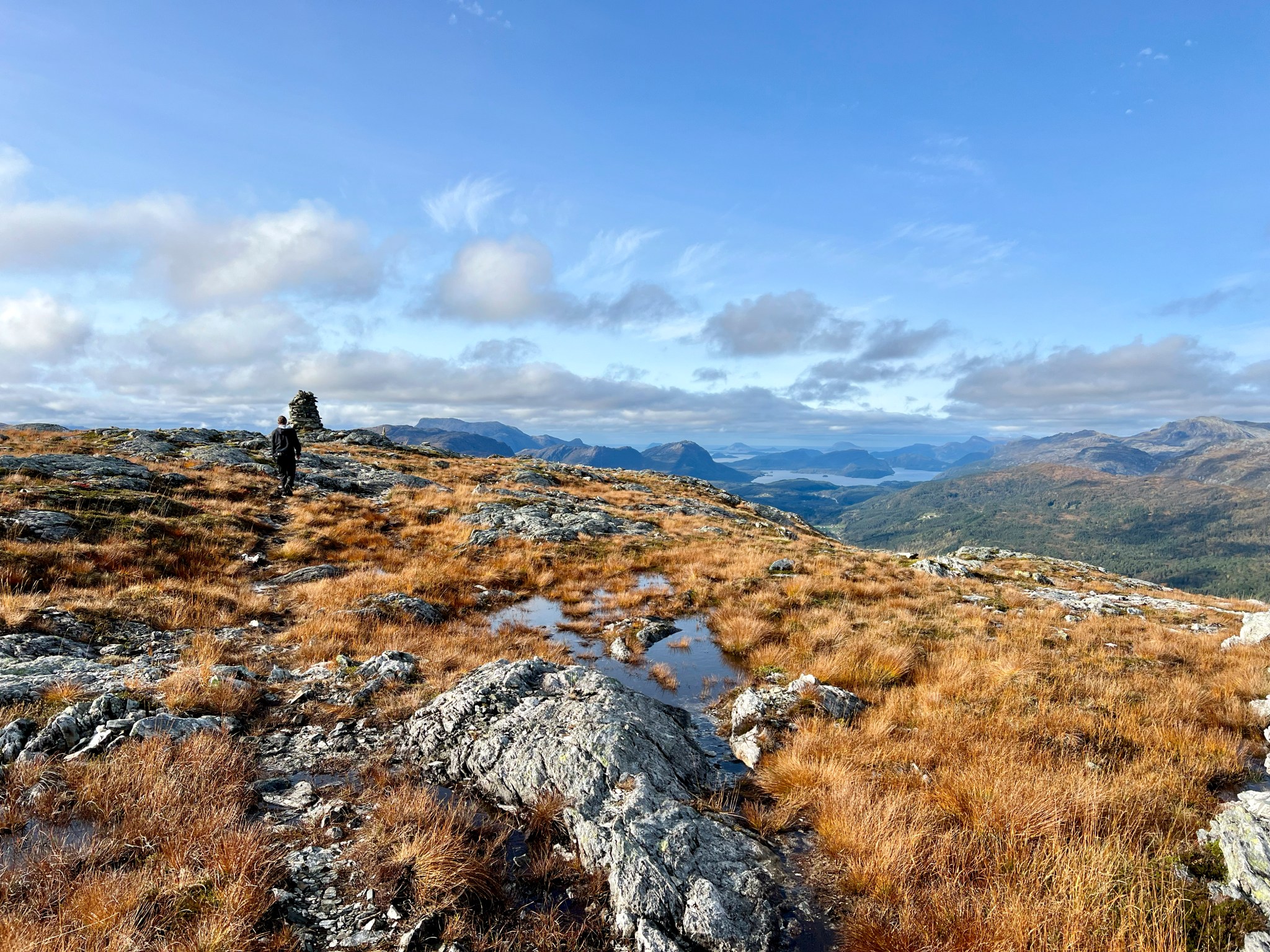
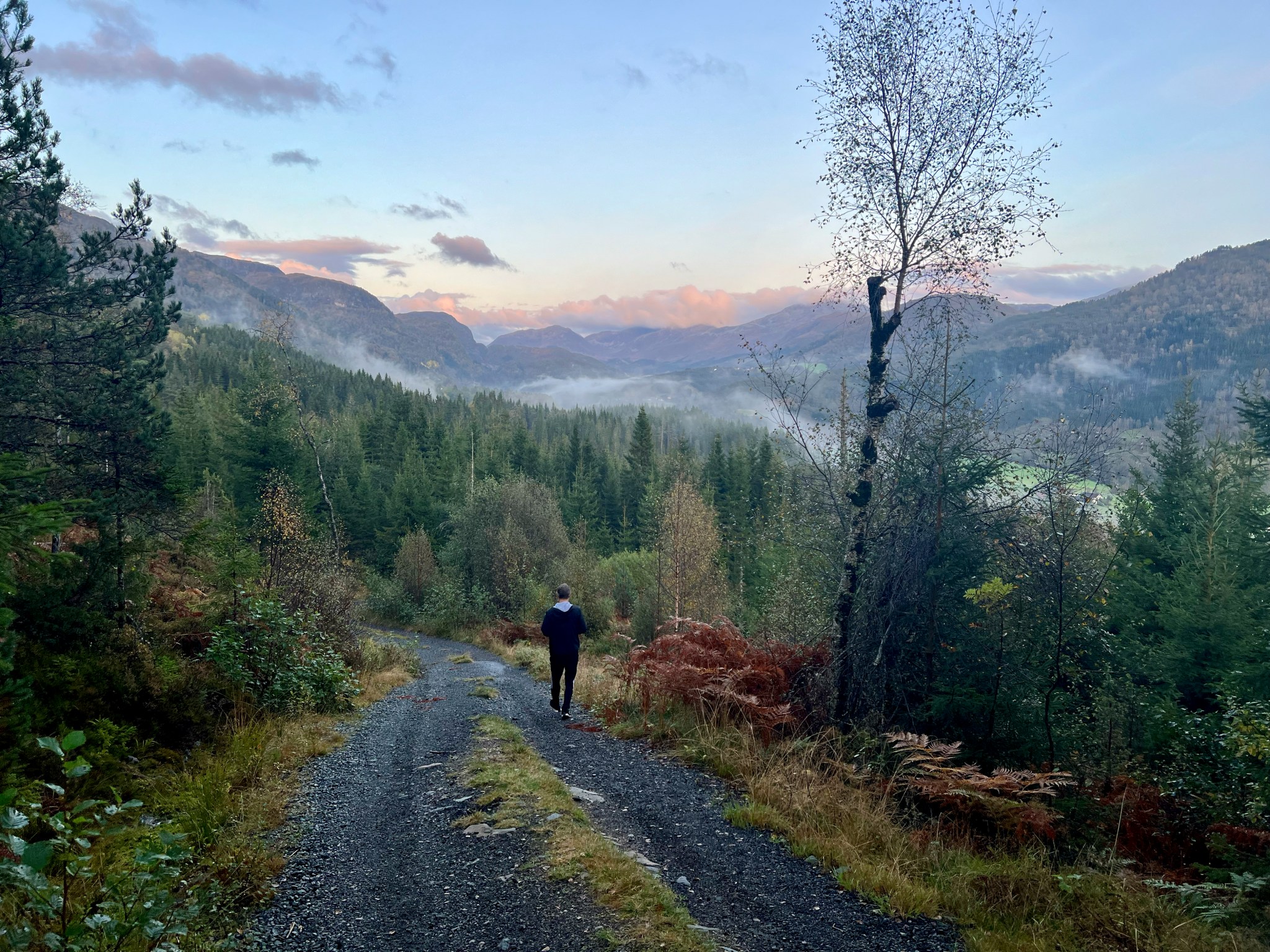
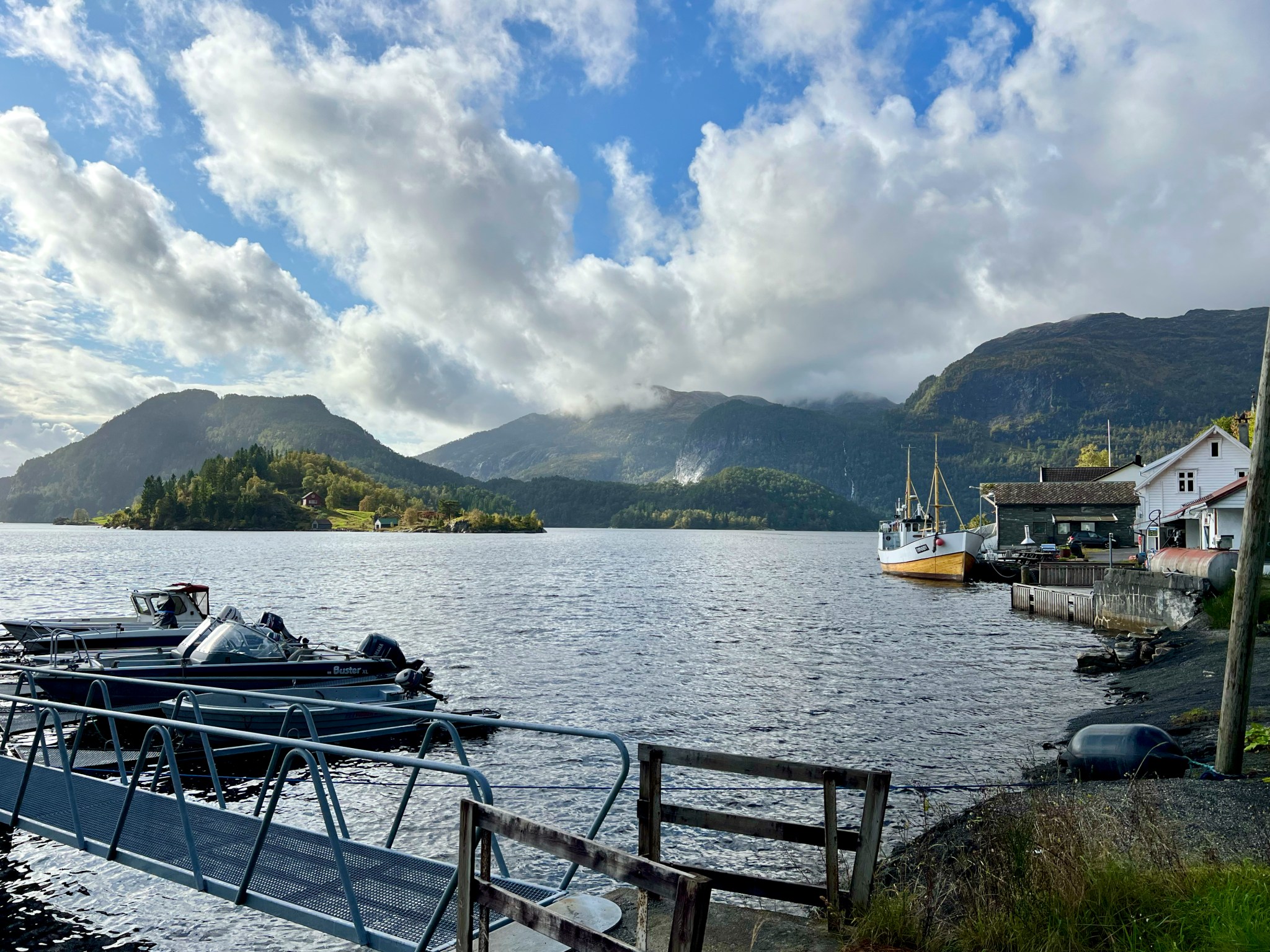
Photo Shoot!!! A mix from my Sony A7ii and my iPhone 13 Pro, which almost looks better due to the wider angle
Sources
https://worldpopulationreview.com/world-cities/bergen-population
https://whc.unesco.org/en/list/59/
https://www.floyen.no/en/floibanen
https://www.alltrails.com/trail/norway/sogn-og-fjordane/prest?u=i

 WatchYaGot
Leave a comment